FHB Logo Facebook LinkedIn Email Pinterest Twitter X Instagram Tiktok YouTube Plus Icon Close Icon Navigation Search Icon Navigation Search Icon Arrow Down Icon Video Guide Icon Article Guide Icon Modal Close Icon Guide Search Icon Skip to content
Subscribe
Log In
  • How-To
  • Design
  • Tools & Materials
  • Restoration
  • Videos
  • Blogs
  • Forum
  • Magazine
  • Members
  • FHB House
  • Podcast
Log In

The Best Way to Ventilate Siding
By Daniel Morrison
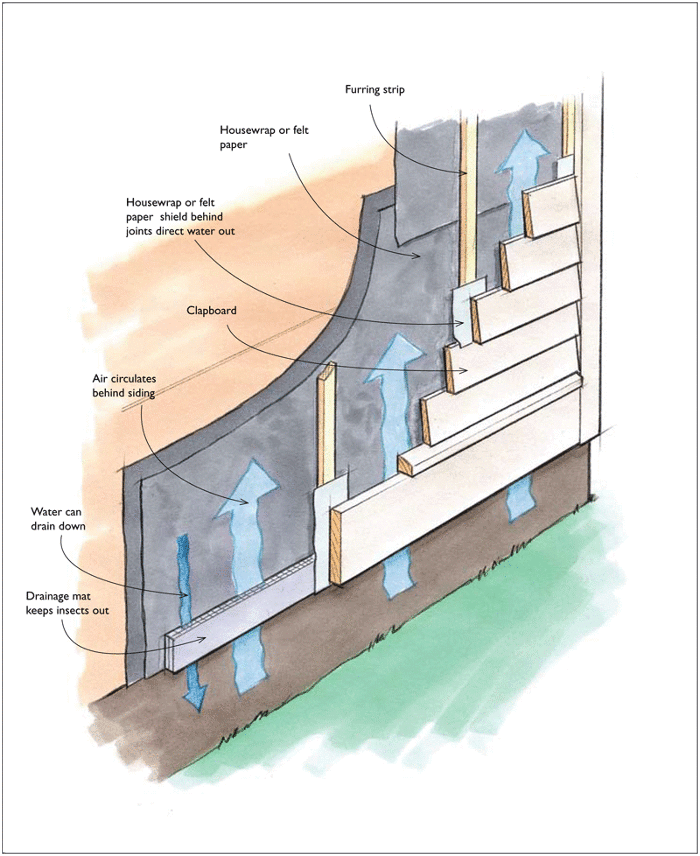
Paint lasts longer when the siding is vented. Vertical strapping lets water drain down and air flow up. This allows the back of the siding to dry as fast as the front, keeping the wood stable and extending the life of the paint, siding, and sheathing.

In researching an article for the magazine, senior editor Justin Fink sent an email to the Green Building Advisor Help Desk. A couple of good replies came in from John Straube and Joe Lstiburek, which we thought the FHB readers would find useful, intertesting, or both.

The question:

Gentlemen,

I’m researching/writing an article about vented rainscreens for Fine Homebuilding. Though most building scientists/disciples seem to be in general agreement about 90% of the overarching concepts, I’m finding contradictory information on two areas:

1.) Should venting be continuous around inside and outside corners, or broken up so each face of the house is a separate unit?

2.) Is it a good idea to tie the “exhaust” end of the vented rainscreen to the roof venting setup, or safer/just as effective to vent it under the soffits (at the fascia board)?

John Straube, principle at Building Science Corporation and professor of engineering at University of Waterloo, answers:

I am somewhat passionate about this topic since I have spent years studying it in great depth. I may be the only person on this list who has comprehensively measured the pressures behind claddings in real buildings. I would like to see other data if my assumption is incorrect. Much of my PhD work focused on the topic of pressure equalization and ventilation drying and so I spent more than 3 years measuring pressures at 1 to 3 second intervals in 200 spots around a building. At the time, the quantity of data, measured in GigaBytes was a source of wonder to geeks.


Wind only makes exisiting leaks worse — it’s not the source of the problem

Despite what people want to believe, wind pressure has little to do with why claddings like siding, brick and stucco leak. Wind has a lot to do with depositing rain on such walls. If you test normal walls in the field (which is a focus of our forensic work in this field) one does not need to apply air pressure to reproduce problematic leaks. Adding lots of air pressure (hurricane force winds) definitely increases the rate of leakage of water, but usually problems relate NOT to hurricanes, but normal windy days.
The erroneous connection people make to “it leaks when it is windy and rainy” to “air pressures cause my cladding to leak” is a big part of the confusion regarding pressure moderation.

That said, any vented cladding over a good air barrier will not experience very large sustained air pressures across the cladding.


Ventilate to dry your siding and sheathing

The reason to vent is not primarily, or even tertiarily, to deal with rain penetration but to encourage the through flow of air, ventilation, which encourages drying. Ventilation of claddings over moisture sensitive substrates and/or moisture sensitive claddings (eg wood!) is a critical aspect of durability and in-service performance.

There is no evidence in physics or field experience that supports the contention that vents at the top of walls under soffits or projecting parapets cause any performance reduction. In fact, all of the evidence supports the opposite. When we did a big study for ASHRAE a few years ago, we had two identical walls, one with vents top and bottom and one with vents only at the bottom. The top and bottom vent was consistently drier, and was able to dry out injected water much more quickly. Skeptics said “that is because your walls may not have been built identically the same”. So we open the top vents on the bottom vent only wall, and sealed the top vents of the top and bottom vent wall for the 3rd year of the study. The results were absolutely replicated: vent top and bottom far superior to vents only at bottom. The physics are obvious. You MUST have through flow to get the benefits of venting. Venting at one vertical or horizontal line does not provide any significant benefits. Widely spread vents provide significant benefits.

PS. We also measure pressure performance behind brick veneers with the top only vents and the bottom only vents. The two walls had the same pressure response for detailed but explicable technical reasons.


For more on siding, see the article at Green Building Advisor:


Fine Homebuilding Recommended Products

Fine Homebuilding receives a commission for items purchased through links on this site, including Amazon Associates and other affiliate advertising programs.

All New Bathroom Ideas that Work
Everyone wants their bathrooms to be beautiful, but few know the challenge of arranging all the fixtures, storage, and convenience of a great bathroom into one of the smallest space in our homes. This book has hundreds of ideas to inspire you.
Buy at Amazon

Graphic Guide to Frame Construction

Now in it’s 5th edition, Rob Thallon’s book for builders has been a go-to resource for decades. This book features clear graphics that will help you understand how nearly all American houses are — or should be — built.
Buy at Amazon

Get Your House Right: Architectural Elements to Use & Avoid

If you are designing or remodeling a traditional home and want to make sure that you get all the finish details right, this book is for you. Marianne’s drawings are illustrative, covering every aspect of interior and exterior finishes.
Buy at Amazon

Sign up for eletters today and get the latest how-to from Fine Homebuilding, plus special offers.

Signing you up...

This site is protected by reCAPTCHA and the Google Privacy Policy and Terms of Service apply.
See all newsletters
See all newsletters

Paint lasts longer when the siding is vented. Vertical strapping lets water drain down and air flow up. This allows the back of the siding to dry as fast as the front, keeping the wood stable and extending the life of the paint, siding, and sheathing.

×

Get home building tips, offers, and expert advice in your inbox

Signing you up...

This site is protected by reCAPTCHA and the Google Privacy Policy and Terms of Service apply.
See all newsletters
See all newsletters

New Feature

Fine Homebuilding Forums

Ask questions, offer advice, and share your work

View Comments

  1. jdh256 | Apr 21, 2010 12:51pm | #1

    What is the recommeded material used for insect screens at the top and bottom venting locations on this setup?

  2. DanMorrison | Apr 23, 2010 12:33pm | #2

    Drainage mat material, such as Cedar Breather,works. Also I've heard of people using ridge vent material (CoraVent).

  3. GregW3 | Jun 21, 2010 02:41am | #3

    I cant see much benifit in this. My 100 year old siding is on top of 30# tarpaper which is on top of T&G boarding. During my renovation I saw no, I mean absolutely no sign of water getting behind my siding anywhere. That picture looks like a great place for critters to live and water to condensate. No thanks.

  4. civiletti | Jul 14, 2010 02:54am | #4

    Properly detailed, vented siding will keep out creatures. I used stacked black corrugated sign plastic with fiberglass insect screen wrapped around it at the top and bottom of each bay. Cor-A-Vent or Cedar Breather also work, albeit at higher cost.

    Rain infiltration is one of the most common causes of water damage in walls. Modern, highly insulated walls are less forgiving than older leaky systems.

  5. TannerC | Mar 22, 2019 02:46pm | #5

    Did anyone else notice that neither question was directly answered????

Log in or create an account to post a comment.

Sign up Log in

Become a member and get full access to FineHomebuilding.com

Up Next

Video Shorts

Featured Story

Rainscreen for Cedar Shingles

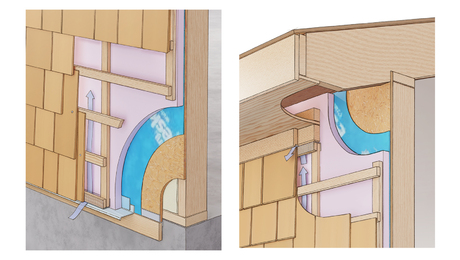
Create a crisscross rainscreen with vertical and horizontal furring strips to provide proper drainage, ventilation, and nailing support over continuous insulation.

Featured Video

A Modern California Home Wrapped in Rockwool Insulation for Energy Efficiency and Fire Resistance

The designer and builder of the 2018 Fine Homebuilding House detail why they chose mineral-wool batts and high-density boards for all of their insulation needs.

Related Stories

  • Do This, Not That: When Attaching a Handrail
  • Rescuing Old Furniture by Refinishing
  • A 1980s Condo Goes Retro Vintage
  • Eastlake Galley

Discussion Forum

Recent Posts and Replies

  • |
  • |
  • |
  • |
  • |
  • |
View More Create Post

Highlights

Fine Homebuilding All Access
Fine Homebuilding Podcast
Tool Tech
Plus, get an extra 20% off with code GIFT20

"I have learned so much thanks to the searchable articles on the FHB website. I can confidently say that I expect to be a life-long subscriber." - M.K.

Get home building tips, offers, and expert advice in your inbox

Signing you up...

This site is protected by reCAPTCHA and the Google Privacy Policy and Terms of Service apply.
See all newsletters
See all newsletters

Video

View All Videos
  • FHB Podcast Segment: Waterproofing Below-Grade Foundation Walls
  • FHB Podcast Segment: Can You Have Too Many Minisplits?
  • FHB Podcast Segment: Finding Hazardous Materials in a Fixer-Upper
  • FHB Podcast Segment: Embodied Greenhouse Gas Emissions and the Building Codes
View All

Design and Planning

View All Design and Planning Articles
  • FHB Podcast Segment: Insulating a Shed Roof Without Spray Foam
  • Maine Addition
  • Do This, Not That: Regarding Porch Details
View All Design and Planning Articles

Fine Homebuilding Magazine

  • Issue 333 - August/September 2025
    • A Practical Perfect Wall
    • Landscape Lighting Essentials
    • Repairing a Modern Window Sash
  • Issue 332 - July 2025
    • Custom Built-ins With Job-Site Tools
    • Fight House Fires Through Design
    • Making the Move to Multifamily
  • Issue 331 - June 2025
    • A More Resilient Roof
    • Tool Test: You Need a Drywall Sander
    • Ducted vs. Ductless Heat Pumps
  • Issue 330 - April/May 2025
    • Deck Details for Durability
    • FAQs on HPWHs
    • 10 Tips for a Long-Lasting Paint Job
  • Issue 329 - Feb/Mar 2025
    • Smart Foundation for a Small Addition
    • A Kominka Comes West
    • Making Small Kitchens Work

Fine Home Building

Newsletter Sign-up

  • Fine Homebuilding

    Home building tips, offers, and expert advice in your inbox.

  • Green Building Advisor

    Building science and energy efficiency advice, plus special offers, in your inbox.

  • Old House Journal

    Repair, renovation, and restoration tips, plus special offers, in your inbox.

Signing you up...

This site is protected by reCAPTCHA and the Google Privacy Policy and Terms of Service apply.
See all newsletters

Follow

  • Fine Homebuilding

    Dig into cutting-edge approaches and decades of proven solutions with total access to our experts and tradespeople.

    Start Free Trial Now
    • Facebook
    • Instagram
    • X
    • LinkedIn
  • GBA Prime

    Get instant access to the latest developments in green building, research, and reports from the field.

    Start Free Trial Now
    • Facebook
    • YouTube
  • Old House Journal

    Learn how to restore, repair, update, and decorate your home.

    Subscribe Now
    • Facebook
    • Instagram
    • X
  • Fine Homebuilding

    Dig into cutting-edge approaches and decades of proven solutions with total access to our experts and tradespeople.

    Start Free Trial Now
    • Facebook
    • Instagram
    • X
    • LinkedIn
  • GBA Prime

    Get instant access to the latest developments in green building, research, and reports from the field.

    Start Free Trial Now
    • Facebook
    • YouTube
  • Old House Journal

    Learn how to restore, repair, update, and decorate your home.

    Subscribe Now
    • Facebook
    • Instagram
    • X

Membership & Magazine

  • Online Archive
  • Start Free Trial
  • Magazine Subscription
  • Magazine Renewal
  • Gift a Subscription
  • Customer Support
  • Privacy Preferences
  • About
  • Contact
  • Advertise
  • Careers
  • Terms of Use
  • Site Map
  • Do not sell or share my information
  • Privacy Policy
  • Accessibility
  • California Privacy Rights

© 2025 Active Interest Media. All rights reserved.

Fine Homebuilding receives a commission for items purchased through links on this site, including Amazon Associates and other affiliate advertising programs.

X
X
This is a dialog window which overlays the main content of the page. The modal window is a 'site map' of the most critical areas of the site. Pressing the Escape (ESC) button will close the modal and bring you back to where you were on the page.

Main Menu

  • How-To
  • Design
  • Tools & Materials
  • Restoration
  • Video
  • Blogs
  • Forum
  • Project Guides
  • Reader Projects
  • Magazine
  • Members
  • FHB House

Podcasts

  • FHB Podcast
  • ProTalk

Webinars

  • Upcoming and On-Demand

Podcasts

  • FHB Podcast
  • ProTalk

Webinars

  • Upcoming and On-Demand

Popular Topics

  • Kitchens
  • Business
  • Bedrooms
  • Roofs
  • Architecture and Design
  • Green Building
  • Decks
  • Framing
  • Safety
  • Remodeling
  • Bathrooms
  • Windows
  • Tilework
  • Ceilings
  • HVAC

Magazine

  • Current Issue
  • Past Issues
  • Magazine Index
  • Subscribe
  • Online Archive
  • Author Guidelines

All Access

  • Member Home
  • Start Free Trial
  • Gift Membership

Online Learning

  • Courses
  • Project Guides
  • Reader Projects
  • Podcast

More

  • FHB Ambassadors
  • FHB House
  • Customer Support

Account

  • Log In
  • Join

Newsletter

Get home building tips, offers, and expert advice in your inbox

Signing you up...

This site is protected by reCAPTCHA and the Google Privacy Policy and Terms of Service apply.
See all newsletters
See all newsletters

Follow

  • X
  • YouTube
  • instagram
  • facebook
  • pinterest
  • Tiktok

Join All Access

Become a member and get instant access to thousands of videos, how-tos, tool reviews, and design features.

Start Your Free Trial

Subscribe

FHB Magazine

Start your subscription today and save up to 81%

Subscribe

We hope you’ve enjoyed your free articles. To keep reading, become a member today.

Get complete site access to expert advice, how-to videos, Code Check, and more, plus the print magazine.

Start your FREE trial

Already a member? Log in