Podcast Episode 694: Bath Fans, Too Many Minisplits, and Second-Story Additions
Listeners write in about fire-rated doors, using seven minisplits for cooling, and how to build a second-story addition.
Welcome to the Fine Homebuilding podcast, our weekly discussion of building, remodeling, and design topics aimed at anybody who cares deeply about the craft and science of working on houses. This is senior editor Patrick McCombe. I’m joined by Green Building Advisor Randy Williams, contributing editor and production manager for TDS Custom Construction Ian Schwandt, and producer Cari Delahanty. Please email us your questions to [email protected].
You can find previous podcasts and check out the show notes at finehomebuilding.com/podcast.
Check in:
Ian’s economic outlook: Economic indicators like shipping
Patrick: What about pump jacks?
Listener Feedback 1: High-performance fire doors
Ryan writes:
Hi FHB Podcast,
With Grant joining and all the talk of fire safety, I wanted to ask about high-performance fire doors, specifically the entry door connecting the garage and house. My understanding is that code requires doors connecting the garage to be fire-rated at a minimum of 20 minutes. I have looked and called around to high-performance window/door companies, but none have a fire-rated high-performance door.
I believe most architects get around this requirement with a vestibule between the garage and home—a fire door on the garage side and a high-performance door on the home side. This system works, but I am curious if you guys have any insight into other solutions to avoid the vestibule? Fingers crossed the window/door manufacturers work to fill this gap in the market.
Love the show!
Ryan
RELATED STORIES
Listener Feedback 2: Bath fan make-up air
Derek writes:
Hello esteemed FHB team,
I am a builder in Northern California who is all in on high performance and builds to the Pretty Good House standard anytime I can, even when we don’t always get paid to do it.🙄 Recently I built an ADU attached to my own home to provide multi-generational housing for the family. The ADU was constructed using ICFs and was detailed with air-sealing in mind. I haven’t put a blower door on it, but anecdotally it is quite tight.
Anticipating this, I made provisions for range-hood makeup air using RangeRelief and a filtered and interlocked fresh-air damper tied into the HVAC returns (smoke and pollen are an issue here). In the absence of a plug-and-play solution for the clothes dryer, I have a timer switch next to the dryer that opens the same damper for a prescribed time while the dryer is operating. There is also a separately ducted ERV for ventilation.
What has caught me by surprise, is how much my Panasonic bathroom exhaust fans are struggling. As I’ve consulted GBA over the years on the topic of makeup air, the idea of providing it for bathroom fans always seemed to be dismissed as unnecessary. The reasoning being that surely there are enough cracks and gaps in the assembly, doors, and windows to provide what is needed. Well, as it turns out, not so much.
Having installed many of these fans, I’m accustomed to their normal operation and noise—what little noise there is. In the average house they perform with no issues, yet, in my case, I typically hear the electronically commutated motors (ECMs) unsuccessfully laboring to try and reach their CFM set point. If a door or window is opened while they are operating, you can immediately hear the motors ramp down and feel the airflow through the door undercut increase. The audible motor strain and subsequent relief upon providing a hole in the envelope seems to be a clear indication that there are not enough unintended perforations to provide the 80 CFM the fan is attempting to exhaust.
I bring this up for the sake of other builders who may not realize this could be an issue when the house gets tight enough. As you’ve often expressed, ventilation is easily addressed during construction but can be quite a drag after the fact. In my case, I’ll install a smart switch as my fan timer that can then be programmed to control a smart outlet that the fresh-air damper transformer is plugged into, creating a smart interlock. Had I anticipated this issue, I would have hardwired all the bath fans and the range hood to a combination relay transformer that would then open the damper to relieve the negative pressure.
Keep up the good work and thank you for the weekly motivation to carry on.
Derek
RELATED STORIES
- Makeup Air for Tight Houses
- The Basics of Makeup Air
- GBA: Choosing the Right Range Hood Makeup Air System
Question 1: Too many minisplits?
Jeff writes:
Dear FHB Podcast Crew,
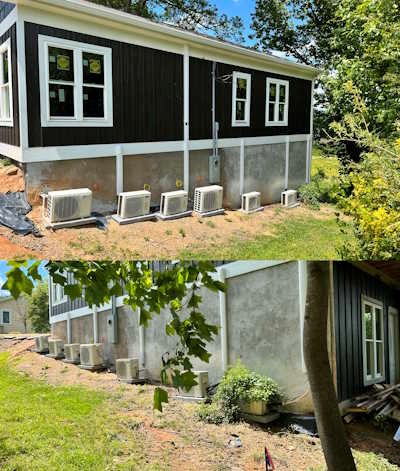
I had to share this photo to get your thoughts on what this HVAC approach might be. It is a spec house under construction in climate zone 4 at an undisclosed location with a name withheld to protect the guilty (or possibly innocent) that has seven minisplit condenser units installed along the side of the house.
The house is probably 1600 sq. ft. (20×40) including the walkout basement. My guess is that it is a three-bedroom/two-bath home based on other new construction in the area. Two of the seven minisplit units are larger than the other five, so it appears some design was done (or at least some thought to sizing the units). Our friend lives next door to the house, so she gets to enjoy this view—and likely the noise when most or all of them are running at one time.
Is there a case where it makes sense financially or from a building science perspective to install so many minisplits for a house this size? Thanks for the insight.
Jeff
RELATED STORIES
Question 2: Prebuilding a second-story addition
Tyler from Maine writes on GBA:
Does anyone here have experience or thoughts on using panelized walls and a trussed roof assembled on the ground (all craned into place) as a way to add a second-story addition?
It (or something like it) seems like the obvious way to go for a second-story addition, but I have no actual experience with it, and it doesn’t get talked about much in that context.
My thinking is that craning the walls and roof (with at least sheathing on it, if not more) would not only significantly reduce dry-in time, but would also likely save money. The most significant drawback I see written about is the need for planning and making sure things align. What other big-picture issues am I not thinking about?
For context, the hypothetical project would be a simple 8/12 gable roof sized at 30 ft. by 34 ft. I live in Maine, where you really can’t count on long stretches of dry weather. There’s plenty of ground space for assembling the roof assembly. I am actually a bit perplexed how people manage to do second-story additions conventionally. It would seem things are guaranteed to get soaked.
Jason Webster from Huntington Homes responds:
Buckle up. Here’s more answer than I’m sure you want.
Modules in general ship as six finished sides (one floor, four walls, and one ceiling). The two long exterior walls are structural. Any walls inside the modules are partitional only. When we place two modules next to each other, the center marriage wall is structural.
On single-floor homes, there’s a hinged roof truss on top of the first floor’s finished Sheetrock ceiling. This hinged truss makes the module short enough that we can ship it down the road. Onsite we use a crane to lift the hinged truss into position. There are kneewalls that transfer half of the roof load to the center marriage wall.
On two-story homes, the first-floor modules are still shipped as six finished sides (floor, four walls, and one ceiling), but sans a folding truss on top. We then stack another six-sided module on top of it. This gives all modular homes the tell-tale “double-stack” height between floors.
When we do second-floor additions to our homes, we cut the old folding truss off but leave the old finished Sheetrock ceiling. The old single-floor modules already have a structural marriage wall in the center of the home. We simply set new modules on top.
The only real coordination challenges are stairs and MEP risers. Oh and not getting the first floor wet. Site-built single-floor homes usually don’t have a center structural wall, and we don’t know how they’re built until we deconstruct them, so we just don’t have the time to pre-plan/build the modules.
We just set a second-story addition on a home we’d built here in Central Vermont. The new owner of the home is the son of one of our original electricians. A few of the carpenters that worked on the job are also two generations deep with our company.
Keep up the good work. I look forward to new episodes every Friday morning.
RELATED STORIES
- The Pros and Cons of a Panelized Home
- VIDEO: Making Modular Building More Efficient
- Tying in an Addition to an Existing House
Sign up for the Fine Homebuilding Summit
That is all the time we have for today. Thanks to Ian, Randy, and Cari for joining me and thanks to all of you for listening. Remember to send us your questions and suggestions to [email protected] and please like, comment, or review us no matter how you’re listening–it helps other folks find our podcast.
Fine Homebuilding Recommended Products
Fine Homebuilding receives a commission for items purchased through links on this site, including Amazon Associates and other affiliate advertising programs.

Handy Heat Gun

8067 All-Weather Flashing Tape

Affordable IR Camera