FHB Logo Facebook LinkedIn Email Pinterest Twitter X Instagram Tiktok YouTube Plus Icon Close Icon Navigation Search Icon Navigation Search Icon Arrow Down Icon Video Guide Icon Article Guide Icon Modal Close Icon Guide Search Icon Skip to content
Subscribe
Log In
  • How-To
  • Design
  • Tools & Materials
  • Restoration
  • Videos
  • Blogs
  • Forum
  • Magazine
  • Members
  • FHB House
  • Podcast
Log In
Home-Building Cyclopedia

Makeup Air for Tight Houses

As houses get tighter in order to save energy, makeup air for range hoods and woodstoves becomes a more pressing issue.
By Fine Homebuilding Editors

Houses with very low air-leakage rates are a boon for energy efficiency and indoor comfort. But maintaining healthy indoor-air quality in a tight house can pose challenges, particularly if you’re thinking about a big range hood in the kitchen.

Here’s the problem: When a range hood sucks a large volume of air out of the kitchen, replacement air will be drawn in from somewhere else to replace it. When that source of air is a chimney where a gas-burning furnace or water heater is vented, carbon monoxide can come with it. That’s called backdrafting, and it’s dangerous. Replacement air also might come from a damp and moldy crawlspace, or a dusty attic.

Range hoods can be very powerful — jettisoning as much as 1500 cubic feet of indoor air per minute. The International Residential Code doesn’t require makeup air for a range hood rated at less than 400 cfm. But above that threshold it’s a problem that should be addressed.

Although not as powerful, a variety of other households appliances also contribute to pulling air out of the house — bathroom fans, clothes dryers, fireplaces, woodstoves, and central vacuums. Should they, too, get makeup air? Maybe.

Here’s how to tackle the problem

Tight houses often have a heat-recovery or energy-recovery ventilator, but this equipment is not capable or providing enough makeup air for a large-capacity range hood.

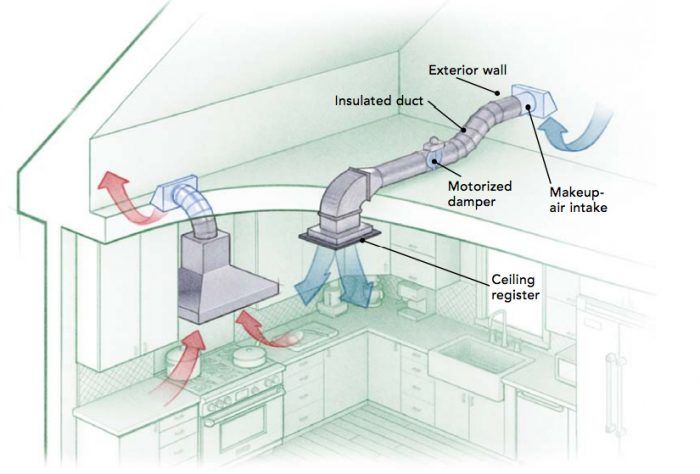
There are several possible solutions. One is to install an outside air duct connected to a grille in the ceiling or wall. Rhode Island builder and FHB editorial adviser Mike Guertin has used a variation on this approach by drawing in makeup air from the outside and routing it under a kitchen cabinet. An automatic mechanical damper on the intake duct opens when a venturi switch on the exhaust duct senses air flow.

In a paper for Building Science Corp., Joseph Lstiburek recommends a two-tiered approach for range hoods that draw more than 400 cfm. Some makeup air is provided by what he calls a modified backwall approach in which unconditioned air is introduced at floor level. This volume of air should not exceed 60% to 70% of the hood exhaust. A second system provides the rest of the makeup air, plus a little extra, at ceiling level at the perimeter of the kitchen. In Lstiburek’s approach, these interlocked systems separate the kitchen from the rest of the HVAC system in the house. The kitchen is “uncoupled.”

There are a few other ways of providing makeup air or otherwise addressing the problem:

  • Connect an outside air duct to the plenum on the furnace (if the house has a forced-air heating and cooling system).
  • Install a makeup air kit from Fantech or Electro Industries. These are through-the-wall systems that balance the amount of outgoing air with an equal amount of incoming air. Incoming air can be heated with electric resistance strips.
  • Skip the range hood altogether and install a recirculating hood with a replaceable charcoal filter. That’s a tactic that Passive House builders may use, although it won’t satisfy cooks who are fond of blackened redfish and other smoky recipes that produce a lot of vaporized grease.

Woodstoves are another issue

Lstiburek would provide makeup air for clothes dryers, fireplaces and kitchen range hoods drawing less than 200 cfm by installing a duct for makeup air in another part of the house. This tempers the incoming air.

What about woodstoves? In a very tight house, a woodstove may not draw well if it doesn’t have a source of outside combustion air. Air can be ducted to an area near the stove — which is called “proximity air” — or it can be routed directly into the stove.

A direct connection to the stove (if the stove is manufactured with this option in mind) means the stove is getting only the air it needs. Plus, should the stove burn out overnight, a direct connection is not introducing a lot of cold air into the house as a proximity air duct would.

A disadvantage of a direct connection is the risk of fire. If the duct is plastic and the stove backdrafts for any reason, a hot ember could find its way into the duct and start a fire.

Some experts don’t see any need to provide makeup air for a woodstove. But Peter Yost, the technical director at Green Building Advisor, thinks a dedicated combustion air duct is a good idea. A metal duct can be fitted with a back-pressure damper to eliminate the chance of embers entering while it gives the stove a chance to draw properly.

Get the details to effectively provide makeup air for your home

Don’t rely on this overview of where you need makeup air and how to provide it; for a detailed account of reliable solutions for nearly any home read How to Provide Makeup Air for Range Hoods.


More about tight houses:

  • When is a house tight enough to need ventilation?
  • Tight home + winter requires dehumidification
  • Blower-Door Test Record

Fine Homebuilding Recommended Products

Fine Homebuilding receives a commission for items purchased through links on this site, including Amazon Associates and other affiliate advertising programs.

Reliable Crimp Connectors
These reliable, high-quality connectors from Wirefy work on 10-22-gauge wire have heat-shrink insulation to keep out water and road salt.
Buy at Amazon

8067 All-Weather Flashing Tape

Available in 2- to 12-in. widths, this is a good general-purpose flashing tape that sticks well to most things. It features a two-piece release paper, water-shedding layers, and good UV resistance.
Buy at Amazon

Handy Heat Gun

This heat gun is great for drying joint compound, primer and paint when patching drywall and plaster walls. Plus it can soften adhesive, get a very cold small engine to start, and shrink heat-shrink tubing.
Buy at Amazon

Sign up for eletters today and get the latest how-to from Fine Homebuilding, plus special offers.

Signing you up...

This site is protected by reCAPTCHA and the Google Privacy Policy and Terms of Service apply.
See all newsletters
See all newsletters
×

Get home building tips, offers, and expert advice in your inbox

Signing you up...

This site is protected by reCAPTCHA and the Google Privacy Policy and Terms of Service apply.
See all newsletters
See all newsletters

New Feature

Fine Homebuilding Forums

Ask questions, offer advice, and share your work

View Comments

  1. grayrascal | Feb 20, 2019 11:47am | #1

    Nice article about an issue that's becoming more common. Suggest you mention the difference between gas and electric cooking. Cooking with gas produces carbon monoxide (CO) and more moisture. Your statement •Skip the range hood altogether and install a recirculating hood- should mention not a good option with gas cooking and a recirculating will not remove any moisture. Code should list gas ranges must be vented to the exterior.

  2. JimmyCox | Mar 14, 2019 02:18am | #2

    it is really amazing article

  3. SamBaker | Jul 20, 2019 12:23am | #3

    I appreciate your work

  4. authurjackson | Jan 30, 2021 01:36am | #4

    Great effort mate. Thanks for sharing.

Log in or create an account to post a comment.

Sign up Log in

Become a member and get full access to FineHomebuilding.com

More Home-Building Cyclopedia

View All
  • What Is a Home Energy Audit?
  • Garage-Door Openers Are Getting Smarter
  • Radiant Heating and Cooling
  • How to Find Air Leaks in Your House
View All

Up Next

Video Shorts

Featured Story

FHB Summit 2025 — Design, Build, Business

Join some of the most experienced and recognized building professionals for two days of presentations, panel discussions, networking, and more.

Featured Video

Video: Build a Fireplace, Brick by Brick

Watch mason Mike Mehaffey construct a traditional-style fireplace that burns well and meets current building codes.

Related Stories

  • Podcast Episode 698: Price Volatility, Carbon Accounting, and Building Off-Grid
  • Podcast Episode 697: Sound Control, Insulating Shed Roofs, and Low-Yield Wells
  • Podcast Episode 696: Fire Prevention, Heat Pumps and Extreme Temperatures, and Rain in Gable Vents
  • Podcast Episode 695: Saving Bricks, Cut-and-Cobble Insulation, and Waterproofing Foundations

Discussion Forum

Recent Posts and Replies

  • |
  • |
  • |
  • |
  • |
  • |
View More Create Post

Highlights

Fine Homebuilding All Access
Fine Homebuilding Podcast
Tool Tech
Plus, get an extra 20% off with code GIFT20

"I have learned so much thanks to the searchable articles on the FHB website. I can confidently say that I expect to be a life-long subscriber." - M.K.

Get home building tips, offers, and expert advice in your inbox

Signing you up...

This site is protected by reCAPTCHA and the Google Privacy Policy and Terms of Service apply.
See all newsletters
See all newsletters

Video

View All Videos
  • FHB Podcast Segment: Can You Have Too Many Minisplits?
  • A Drip-Free, Through-Window Heat Pump
  • FHB Podcast Segment: Are Single-Room ERVs the Answer?
  • FHB Podcast Segment: Efficient HVAC for a New Build
View All

HVAC

View All HVAC Articles
  • From Victorian to Mid-Century Modern: How Unico Fits Any Older Home
  • FHB Podcast Segment: Are Single-Room ERVs the Answer?
  • Right-Sized Gas Furnace
View All HVAC Articles

Fine Homebuilding Magazine

  • Issue 333 - August/September 2025
    • A Practical Perfect Wall
    • Landscape Lighting Essentials
    • Repairing a Modern Window Sash
  • Issue 332 - July 2025
    • Custom Built-ins With Job-Site Tools
    • Fight House Fires Through Design
    • Making the Move to Multifamily
  • Issue 331 - June 2025
    • A More Resilient Roof
    • Tool Test: You Need a Drywall Sander
    • Ducted vs. Ductless Heat Pumps
  • Issue 330 - April/May 2025
    • Deck Details for Durability
    • FAQs on HPWHs
    • 10 Tips for a Long-Lasting Paint Job
  • Issue 329 - Feb/Mar 2025
    • Smart Foundation for a Small Addition
    • A Kominka Comes West
    • Making Small Kitchens Work

Fine Home Building

Newsletter Sign-up

  • Fine Homebuilding

    Home building tips, offers, and expert advice in your inbox.

  • Green Building Advisor

    Building science and energy efficiency advice, plus special offers, in your inbox.

  • Old House Journal

    Repair, renovation, and restoration tips, plus special offers, in your inbox.

Signing you up...

This site is protected by reCAPTCHA and the Google Privacy Policy and Terms of Service apply.
See all newsletters

Follow

  • Fine Homebuilding

    Dig into cutting-edge approaches and decades of proven solutions with total access to our experts and tradespeople.

    Start Free Trial Now
    • Facebook
    • Instagram
    • X
    • LinkedIn
  • GBA Prime

    Get instant access to the latest developments in green building, research, and reports from the field.

    Start Free Trial Now
    • Facebook
    • YouTube
  • Old House Journal

    Learn how to restore, repair, update, and decorate your home.

    Subscribe Now
    • Facebook
    • Instagram
    • X
  • Fine Homebuilding

    Dig into cutting-edge approaches and decades of proven solutions with total access to our experts and tradespeople.

    Start Free Trial Now
    • Facebook
    • Instagram
    • X
    • LinkedIn
  • GBA Prime

    Get instant access to the latest developments in green building, research, and reports from the field.

    Start Free Trial Now
    • Facebook
    • YouTube
  • Old House Journal

    Learn how to restore, repair, update, and decorate your home.

    Subscribe Now
    • Facebook
    • Instagram
    • X

Membership & Magazine

  • Online Archive
  • Start Free Trial
  • Magazine Subscription
  • Magazine Renewal
  • Gift a Subscription
  • Customer Support
  • Privacy Preferences
  • About
  • Contact
  • Advertise
  • Careers
  • Terms of Use
  • Site Map
  • Do not sell or share my information
  • Privacy Policy
  • Accessibility
  • California Privacy Rights

© 2025 Active Interest Media. All rights reserved.

Fine Homebuilding receives a commission for items purchased through links on this site, including Amazon Associates and other affiliate advertising programs.

X
X
This is a dialog window which overlays the main content of the page. The modal window is a 'site map' of the most critical areas of the site. Pressing the Escape (ESC) button will close the modal and bring you back to where you were on the page.

Main Menu

  • How-To
  • Design
  • Tools & Materials
  • Restoration
  • Video
  • Blogs
  • Forum
  • Project Guides
  • Reader Projects
  • Magazine
  • Members
  • FHB House

Podcasts

  • FHB Podcast
  • ProTalk

Webinars

  • Upcoming and On-Demand

Podcasts

  • FHB Podcast
  • ProTalk

Webinars

  • Upcoming and On-Demand

Popular Topics

  • Kitchens
  • Business
  • Bedrooms
  • Roofs
  • Architecture and Design
  • Green Building
  • Decks
  • Framing
  • Safety
  • Remodeling
  • Bathrooms
  • Windows
  • Tilework
  • Ceilings
  • HVAC

Magazine

  • Current Issue
  • Past Issues
  • Magazine Index
  • Subscribe
  • Online Archive
  • Author Guidelines

All Access

  • Member Home
  • Start Free Trial
  • Gift Membership

Online Learning

  • Courses
  • Project Guides
  • Reader Projects
  • Podcast

More

  • FHB Ambassadors
  • FHB House
  • Customer Support

Account

  • Log In
  • Join

Newsletter

Get home building tips, offers, and expert advice in your inbox

Signing you up...

This site is protected by reCAPTCHA and the Google Privacy Policy and Terms of Service apply.
See all newsletters
See all newsletters

Follow

  • X
  • YouTube
  • instagram
  • facebook
  • pinterest
  • Tiktok

Join All Access

Become a member and get instant access to thousands of videos, how-tos, tool reviews, and design features.

Start Your Free Trial

Subscribe

FHB Magazine

Start your subscription today and save up to 81%

Subscribe

We hope you’ve enjoyed your free articles. To keep reading, become a member today.

Get complete site access to expert advice, how-to videos, Code Check, and more, plus the print magazine.

Start your FREE trial

Already a member? Log in