Do This, Not That: When Attaching a Handrail
Anchor placement is crucial when installing wall-mounted objects.

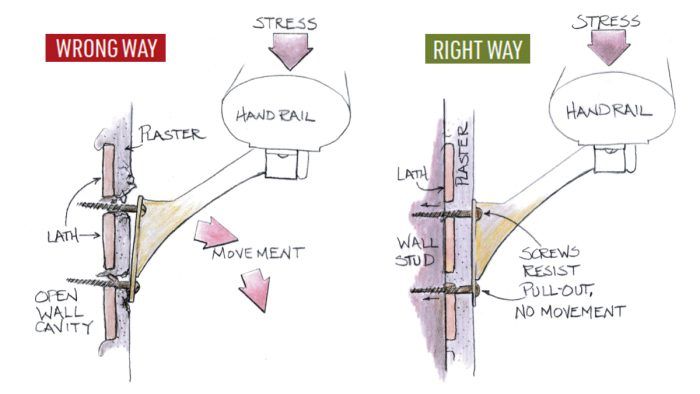
Whether you’re hanging a painting or installing a a wall-mounted stair rail into old lath-and-plaster walls, consider the placement of wall anchors. For most things weighing no more than about 10 pounds, it’s reasonable to use just screws or nails to anchor the object through the plaster to the wood lath. If you’re using nails, pre-drill first to minimize damaging the surface or breaking the plaster keys. If you’re hanging a heavy mirror or painting—and especially if you’re installing a railing—it is essential to anchor into the wall studs behind the plaster. (The rail must support the weight of a person grabbing it during a near fall.) To assure that every rail bracket is anchored into a stud, you may have to let go of strict spacing symmetry.
Properly Attaching a Handrail
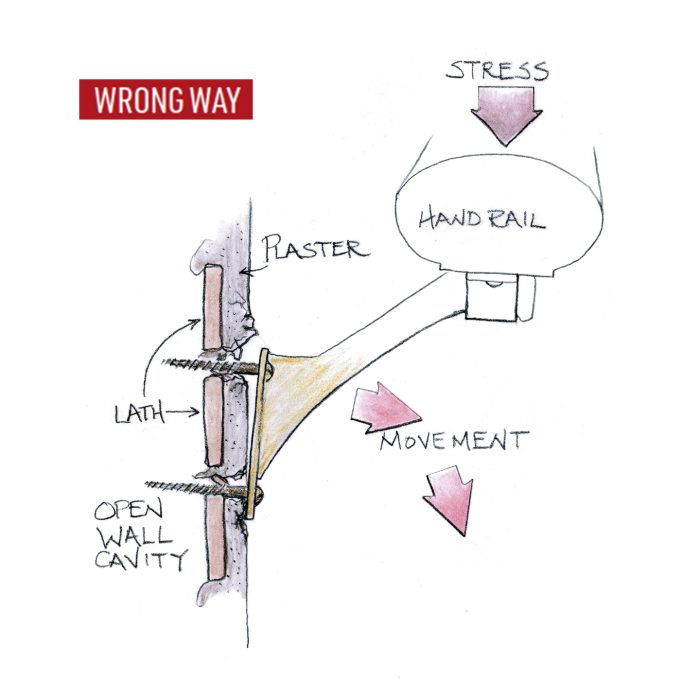
Wrong Way: Too-Neat SpacingMaybe you start at the bottom with a handrail bracket, then insist that subsequent brackets be placed at even intervals. Symmetry is not the goal here. Every bracket should be screwed through plaster and lath into a stud; studs may not be spaced at regular intervals. Screws that simply go through plaster and lath have little resistance to pullout, presenting a hazard. |
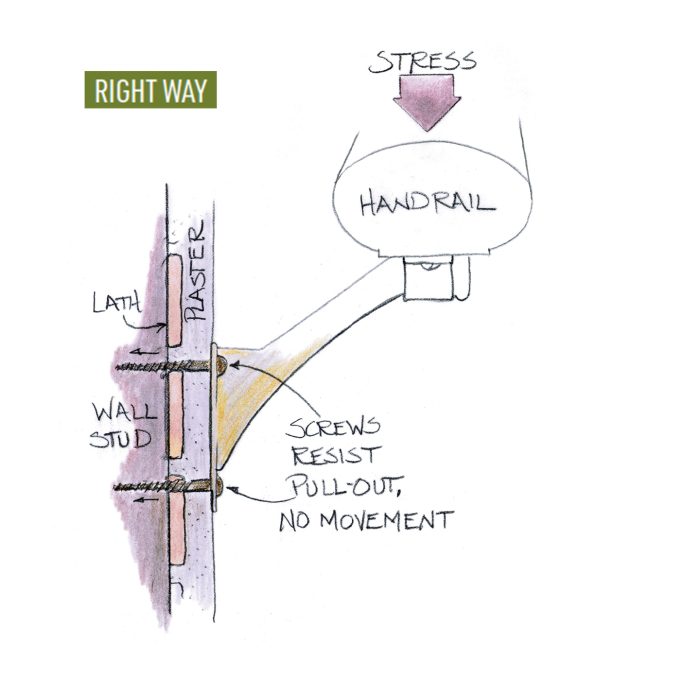
Right Way: Find Your StudsYou must determine where wall studs are located inside the wall. Today’s stud finders are good at pinpointing their locations. Mark stud placements and take note of any irregular spacing you might find. Mark the stud locations and install every bracket at a stud. (You need a bracket every 3 ½ to 4 ½ feet and 6″ to 18″ from each end; double check the code for your specific situation. For a 10′ handrail, you’d need three brackets.) Be sure screws are long enough to penetrate the wall and at least an inch (or more) into the wood stud. |
— Written and illustrated by Ray Tschoepe.
RELATED STORIES