FHB Logo Facebook LinkedIn Email Pinterest Twitter X Instagram Tiktok YouTube Plus Icon Close Icon Navigation Search Icon Navigation Search Icon Arrow Down Icon Video Guide Icon Article Guide Icon Modal Close Icon Guide Search Icon Skip to content
Subscribe
Log In
  • How-To
  • Design
  • Tools & Materials
  • Restoration
  • Videos
  • Blogs
  • Forum
  • Magazine
  • Members
  • FHB House
  • Podcast
Log In
Drawing Board

Garden Sheds With Style

By paying attention to scale and siting thoughtfully, you can transform a storage shed into a garden shed
By Roxana Vargas-Greenan Issue 205

In my neighborhood, the majority of houses have a storage shed tucked somewhere in the backyard. It’s often placed in the most inconspicuous location on the lot with little attention given to its scale, its design, or the quality of its materials.

However, by paying attention to the scale of a storage shed and by placing it sensitively in the landscape, you can transform it into a garden shed, a decorative focal element in the yard.

Purpose and proportions dictate shed size

The first thing you need to determine is the size of the shed, a function of both the shed’s purpose and the size of the garden. Start by considering how the shed will be used. Will it be available for an activity such as potting? Will it be a backyard destination with an adjacent sitting area or patio? What items will be stored in the shed: outdoor tools and toys or overflow items from the house? Make a list of the things you want to store to estimate the space you need.

At a minimum, a garden shed needs to be 3 ft. deep for storage. Shelves maximize storage, but they should be at least 13 in. deep. To improve access, consider double doors to expose more of the interior.

If the shed will be used for an activity such as potting, you’ll need a small work area inside or outside the structure. I like a counter about 3 ft. long and 2 ft. deep. For an inside workspace, you also need room to move around, generally about 3-1/2 ft. of depth (enough for a small chair).

A shed that is too large will look out of place and will diminish the usefulness of the yard. I prefer to limit the footprint of the shed to a proportion of garden size. For small gardens (up to 900 sq. ft.), the shed can be up to 3% or 4% of the garden. For a garden between 900 sq. ft. and 1500 sq. ft., devoting 5% to a shed is OK, but generally, I would not exceed 100 sq. ft. In a garden 3000 sq. ft. or larger, I suggest limiting the shed to 150 sq. ft.

Mimic the house, but reduce the proportions

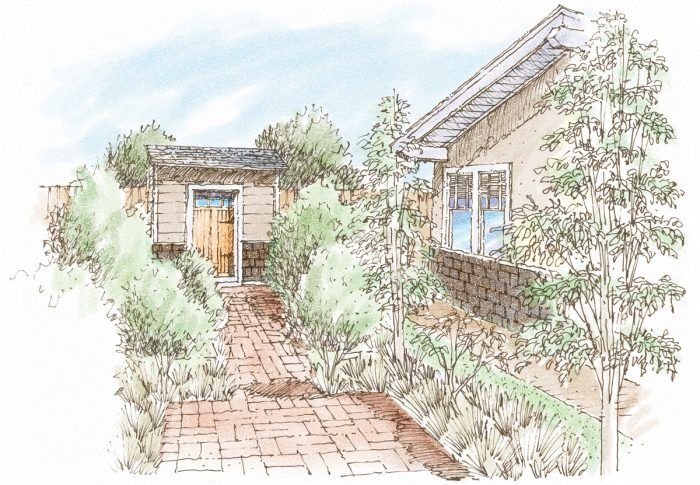
This shed draws inspiration from the house, sharing the primary siding and trim elements. It’s appropriate to reduce the size of the shed’s details proportionally to match its smaller scale. For example, the siding exposure might be reduced, and the rafter tails might be 2x4s instead of the 2x6s on the house. The roof’s low pitch helps to keep the height appropriate for the shed’s 4-ft. by 6-ft. footprint. On small sheds, avoid steep roofs such as a gambrel or front gable. Although there isn’t room for a window, the small glass lites in the door offer enough transparency to prevent a fortress-like feel.


design a garden shed with style

Site the shed thoughtfully

The garden’s style also influences the shed’s placement because the structure should be an integral part of the garden design. If the garden has a formal layout, the shed will likely play a major role as the focal point of several views within the garden. In a more informal or picturesque garden, the shed can be placed along a meandering path or be revealed slowly through layered plantings rather than be seen from all vantage points.

As you think about placement, consider the shadows that the shed will create. Placing the shed on the north side limits shadows and maximizes sunlight in the garden.

You can’t hide a bad design

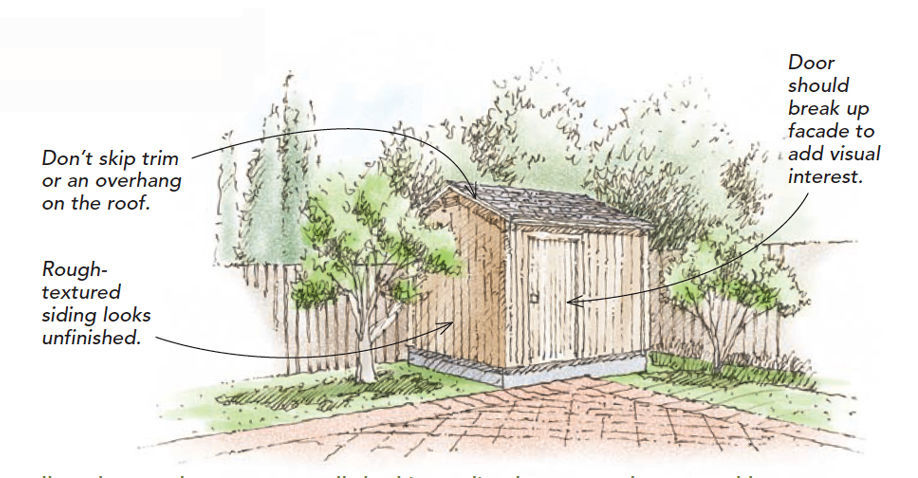
In a small yard or garden, even a small shed immediately attracts the eye and becomes a focal point, so don’t try to hide it by tucking it into a corner. This shed is probably slightly too large for the space, but the problem is exacerbated by a flimsy-looking roof, monolithic facades, and poor-quality materials.


design stylish garden shedDetails create appeal

Generally, the shed’s style draws inspiration from the house. However, if the house doesn’t have a distinctive style or if the garden is far from the house, you have a bit of leeway. In these cases, the plantings can lend themselves to a particular style. For example, softer flowering plants lend themselves to a traditional look, while more structural plants, such as bamboo, can relate to modern designs.

Regardless of style, sheds are viewed close up, so use high-quality materials. I avoid plywood siding and synthetics (vinyl and plastics). I pay particular attention to the craftsmanship of the doors, the size of the roof overhang, and the size and placement of the windows.

The shed’s reduced scale makes the door a prominent visual element. Doors should be a minimum of 6 ft. tall. Their style can vary—carriage-door style, tongue-and-groove planks, or simple patterned doors all work well—but the emphasis should be on quality. For an unpainted door, cedar’s warm color tones and weather resistance work well. Fir and poplar are common for painted doors. I find that iron hardware works well with unpainted wood surfaces, while brass hardware is most appropriate for a more finished design.

The roof should have an overhang to lend mass to the roof edge and to help protect the door. Without it, the shed will have an insubstantial and flimsy appearance. Even a 6-in. overhang can provide a distinct impact.

Windows help to connect the shed to the house and help to break up the facade, especially on sheds that are the focal point of the garden or that are larger than 75 sq. ft. The windows and trim should be similar to those on the house. However, if your budget is small, I suggest passing on the windows and putting the money toward high-quality siding and an attractive door. Use siding that provides texture and shadow, such as clapboards or shingles. If you want the shed to blend in with the landscape, leave the cladding natural, or paint it a shade of green. To distinguish the shed from the garden, add color. The trim color from the house often is a good choice.

With refined details, the shed becomes the focal point

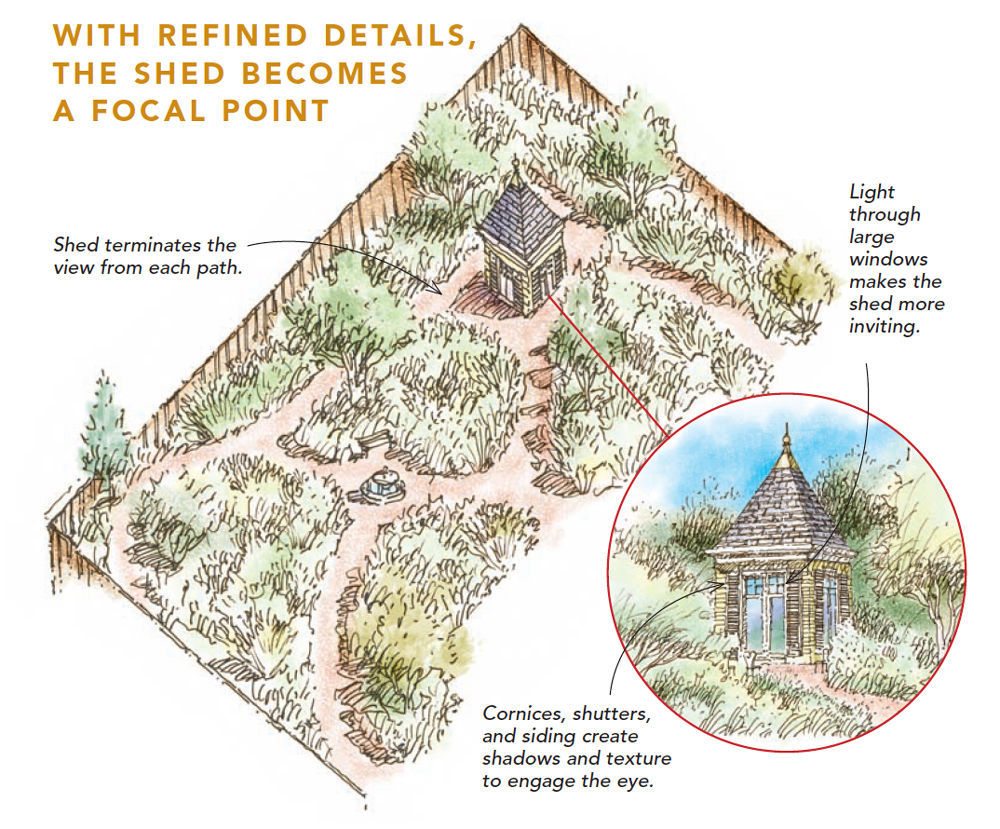
In a larger garden, a shed can be bigger and be designed to be viewed from all sides. Often, a symmetrical garden plan will be centered on the shed with all views terminating at the structure. In this case, the garden is more picturesque than formal, and the location of the shed creates something of a hybrid. The steep roof and finial are visible throughout the yard, so it’s the central element of the garden. Also, the structure incorporates a high level of detail, reflecting its prominence. But the shed is slightly off center, and the curved paths and plantings conspire to hide portions of the shed so that the view changes and surprises as you approach.
design a stylish garden shed


Drawings by: Roxana Vargas-Greenan

Fine Homebuilding Recommended Products

Fine Homebuilding receives a commission for items purchased through links on this site, including Amazon Associates and other affiliate advertising programs.

Code Check 10th Edition: An Illustrated Guide to Building a Safe House

It would be great if this book didn’t need to exist, but it's definitely a must-have. It's a one-size-fits-all code book that's easy to understand and will help you sail through your inspections.
Buy at Amazon

A Field Guide to American Houses

If you want to plan, design, or remodel based on the vast tradition of American architectural styles you first have to understand their history, geography, architectural significance, and relationship to one another. This book can help with that.
Buy at Amazon

A House Needs to Breathe...Or Does It?: An Introduction to Building Science

Allison Bailes is great at explaining complex building science topics in simple terms that anyone can understand. If your goal is a new house or remodel that embodies the best practices that building scientists have to offer, buy this book right away.
Buy at Amazon

Sign up for eletters today and get the latest how-to from Fine Homebuilding, plus special offers.

Signing you up...

This site is protected by reCAPTCHA and the Google Privacy Policy and Terms of Service apply.
See all newsletters
See all newsletters
×

Get home building tips, offers, and expert advice in your inbox

Signing you up...

This site is protected by reCAPTCHA and the Google Privacy Policy and Terms of Service apply.
See all newsletters
See all newsletters

New Feature

Fine Homebuilding Forums

Ask questions, offer advice, and share your work

Log in or create an account to post a comment.

Sign up Log in

Become a member and get full access to FineHomebuilding.com

More Drawing Board

View All
  • Making a Room Under a Deck
  • Balustrades
  • Drawing Board: Second-Floor Additions for a Ranch House
  • Baths with Freestanding Tubs
View All

Up Next

Video Shorts

Featured Story

FHB Summit 2025 — Design, Build, Business

Join some of the most experienced and recognized building professionals for two days of presentations, panel discussions, networking, and more.

Featured Video

Micro-Adjust Deck-Baluster Spacing for an Eye-Deceiving Layout

No math, no measuring—just a simple jig made from an elastic band is all you need to lay out a good-looking deck railing.

Related Stories

  • Rescuing Old Furniture by Refinishing
  • Eastlake Galley
  • Maine Addition
  • Do This, Not That: Regarding Porch Details

Discussion Forum

Recent Posts and Replies

  • |
  • |
  • |
  • |
  • |
  • |
View More Create Post

Highlights

Fine Homebuilding All Access
Fine Homebuilding Podcast
Tool Tech
Plus, get an extra 20% off with code GIFT20

"I have learned so much thanks to the searchable articles on the FHB website. I can confidently say that I expect to be a life-long subscriber." - M.K.

Get home building tips, offers, and expert advice in your inbox

Signing you up...

This site is protected by reCAPTCHA and the Google Privacy Policy and Terms of Service apply.
See all newsletters
See all newsletters

Video

View All Videos
  • FHB Podcast Segment: Waterproofing Below-Grade Foundation Walls
  • FHB Podcast Segment: Can You Have Too Many Minisplits?
  • FHB Podcast Segment: Finding Hazardous Materials in a Fixer-Upper
  • Insulation for Homes in the Wildland Urban Interface
View All

Storage

View All Storage Articles
  • FHB Podcast Segment: Building a Shed Using Salvaged Materials
  • Repurpose Tool Boxes
  • Handy Bit Storage
View All Storage Articles

Fine Homebuilding Magazine

  • Issue 333 - August/September 2025
    • A Practical Perfect Wall
    • Landscape Lighting Essentials
    • Repairing a Modern Window Sash
  • Issue 332 - July 2025
    • Custom Built-ins With Job-Site Tools
    • Fight House Fires Through Design
    • Making the Move to Multifamily
  • Issue 331 - June 2025
    • A More Resilient Roof
    • Tool Test: You Need a Drywall Sander
    • Ducted vs. Ductless Heat Pumps
  • Issue 330 - April/May 2025
    • Deck Details for Durability
    • FAQs on HPWHs
    • 10 Tips for a Long-Lasting Paint Job
  • Issue 329 - Feb/Mar 2025
    • Smart Foundation for a Small Addition
    • A Kominka Comes West
    • Making Small Kitchens Work

Fine Home Building

Newsletter Sign-up

  • Fine Homebuilding

    Home building tips, offers, and expert advice in your inbox.

  • Green Building Advisor

    Building science and energy efficiency advice, plus special offers, in your inbox.

  • Old House Journal

    Repair, renovation, and restoration tips, plus special offers, in your inbox.

Signing you up...

This site is protected by reCAPTCHA and the Google Privacy Policy and Terms of Service apply.
See all newsletters

Follow

  • Fine Homebuilding

    Dig into cutting-edge approaches and decades of proven solutions with total access to our experts and tradespeople.

    Start Free Trial Now
    • Facebook
    • Instagram
    • X
    • LinkedIn
  • GBA Prime

    Get instant access to the latest developments in green building, research, and reports from the field.

    Start Free Trial Now
    • Facebook
    • YouTube
  • Old House Journal

    Learn how to restore, repair, update, and decorate your home.

    Subscribe Now
    • Facebook
    • Instagram
    • X
  • Fine Homebuilding

    Dig into cutting-edge approaches and decades of proven solutions with total access to our experts and tradespeople.

    Start Free Trial Now
    • Facebook
    • Instagram
    • X
    • LinkedIn
  • GBA Prime

    Get instant access to the latest developments in green building, research, and reports from the field.

    Start Free Trial Now
    • Facebook
    • YouTube
  • Old House Journal

    Learn how to restore, repair, update, and decorate your home.

    Subscribe Now
    • Facebook
    • Instagram
    • X

Membership & Magazine

  • Online Archive
  • Start Free Trial
  • Magazine Subscription
  • Magazine Renewal
  • Gift a Subscription
  • Customer Support
  • Privacy Preferences
  • About
  • Contact
  • Advertise
  • Careers
  • Terms of Use
  • Site Map
  • Do not sell or share my information
  • Privacy Policy
  • Accessibility
  • California Privacy Rights

© 2025 Active Interest Media. All rights reserved.

Fine Homebuilding receives a commission for items purchased through links on this site, including Amazon Associates and other affiliate advertising programs.

X
X
This is a dialog window which overlays the main content of the page. The modal window is a 'site map' of the most critical areas of the site. Pressing the Escape (ESC) button will close the modal and bring you back to where you were on the page.

Main Menu

  • How-To
  • Design
  • Tools & Materials
  • Restoration
  • Video
  • Blogs
  • Forum
  • Project Guides
  • Reader Projects
  • Magazine
  • Members
  • FHB House

Podcasts

  • FHB Podcast
  • ProTalk

Webinars

  • Upcoming and On-Demand

Podcasts

  • FHB Podcast
  • ProTalk

Webinars

  • Upcoming and On-Demand

Popular Topics

  • Kitchens
  • Business
  • Bedrooms
  • Roofs
  • Architecture and Design
  • Green Building
  • Decks
  • Framing
  • Safety
  • Remodeling
  • Bathrooms
  • Windows
  • Tilework
  • Ceilings
  • HVAC

Magazine

  • Current Issue
  • Past Issues
  • Magazine Index
  • Subscribe
  • Online Archive
  • Author Guidelines

All Access

  • Member Home
  • Start Free Trial
  • Gift Membership

Online Learning

  • Courses
  • Project Guides
  • Reader Projects
  • Podcast

More

  • FHB Ambassadors
  • FHB House
  • Customer Support

Account

  • Log In
  • Join

Newsletter

Get home building tips, offers, and expert advice in your inbox

Signing you up...

This site is protected by reCAPTCHA and the Google Privacy Policy and Terms of Service apply.
See all newsletters
See all newsletters

Follow

  • X
  • YouTube
  • instagram
  • facebook
  • pinterest
  • Tiktok

Join All Access

Become a member and get instant access to thousands of videos, how-tos, tool reviews, and design features.

Start Your Free Trial

Subscribe

FHB Magazine

Start your subscription today and save up to 81%

Subscribe

We hope you’ve enjoyed your free articles. To keep reading, become a member today.

Get complete site access to expert advice, how-to videos, Code Check, and more, plus the print magazine.

Start your FREE trial

Already a member? Log in