Clear the Air
Get expert recommendations on choosing the right filters for your HVAC system.
In this article, Jon Harrod, contributing editor and HVAC consultant, explains why filters are essential for protecting your HVAC system and improving indoor air quality. He covers how to choose the right filter by balancing particle capture efficiency (MERV rating) with airflow to keep your system running efficiently. He discusses filter placement, how air leaks can reduce filter effectiveness, and the importance of regular filter replacement. The article also reviews different filter types, from standard media filters to carbon and electronic options, as well as options for ductless homes.
Efficient Filtration
Filters may not be a flashy subject, but they are key components in all forced-air heating and cooling systems. They serve two main functions. First, they protect equipment from airborne debris that can reduce its performance and lifespan. Second, they improve indoor air quality (IAQ) by removing airborne particulates.
Particulates are microscopic solids and liquid droplets suspended in the air. They come from sources inside and outside the house and include common allergens like mold spores, pollen, and pet dander. They also include tiny particles known as PM2.5 that can penetrate deep into our lungs and cause serious health problems.
A filter’s efficiency at trapping fine particles is reflected in its MERV (Minimum Efficiency Reporting Value) rating; a higher MERV means a higher particle capture rate. But airflow resistance also increases with MERV. Filters protect HVAC equipment, but installing an overly restrictive filter can actually reduce efficiency and comfort, and cause premature equipment failure.
In this article, I’ll discuss how to select a filter that will capture fine particles without compromising airflow. I’ll also explore how filtration efficiency and airflow change over a filter’s life. I’ll mention pros and cons of locating filters in return grilles or adjacent to the air handler. And I’ll discuss how duct leaks and other defects can allow air to get around a filter, affecting its performance. I’ll focus primarily on media filters, which trap particles in a matrix of spun fibers, but I’ll also touch briefly on other filter types. By the end, you’ll have a clearer understanding of how to select appropriate, high-performing filters for different applications.
Find Your Filter
|


Filters Are Part of a Larger Approach
Filters capture particulates in the air. But filtration is only part of a comprehensive approach to IAQ. Source control—keeping contaminants out of the living space—should be the starting point for every IAQ effort. Dehumidification keeps mold and dust mite activity low. And mechanical ventilation uses outdoor air to dilute pollutants that can’t be removed by other means. All four strategies have their place, and together they form a versatile toolkit that can address most IAQ problems.
For example, filters can’t capture carbon dioxide (CO2), which humans and pets breathe out as a normal part of our metabolism. Only by ventilating—exchanging indoor and outdoor air—can we keep CO2 at healthy levels. And while some higher-end filters may help reduce radon and volatile organic compounds (VOCs), filters should not be thought of as a primary strategy for managing these pollutants. Radon, for example, is best managed through source control (including passive measures like subslab barriers and active mitigation systems) and mechanical ventilation. For VOCs, we can start by selecting low-emission cabinetry, paints, and finishes, and then reduce levels further through ventilation.
Particulate matter comes in a range of sizes and includes dead skin cells, dust mites, soil dust, pollen, mold spores, drywall dust, vehicle exhaust, candle smoke, lead paint and asbestos dust, and much more. While larger particulate matter settles out quickly, smaller particles can remain airborne for hours or even days. Of particular concern are particles less than 2.5 microns in diameter (PM2.5), which can be inhaled deep into our lungs and are linked to a wide range of health problems, including heart disease and cancer.
Filters can capture these particulates, but any conversation about particulate filtration should still begin with source control. Reducing the rate at which particulates enter a home’s air makes it easier to filter out those that do. Outdoor dust and particles get in through gaps and cracks, so meticulous air-sealing helps keep them out, as does closing windows during high-pollution times and using ventilation systems that filter incoming air. Indoors, dust and allergens can be reduced by decluttering, vacuuming well, and cleaning with damp cloths—avoid dry dusting or using poor-quality vacuums that spread dust around.
Mold should be cleaned carefully, and EPA resources can help you decide when to get professional help for managing materials such as lead paint and asbestos. Using electric or induction cooktops and a good range hood helps cut emissions from both fuel and burnt food. Smoking, fireplaces, and candles add indoor pollution, so it’s best to minimize these rather than just rely on filters. Once those steps have been taken, filters play a crucial role by capturing the particulates that still make their way into indoor air.
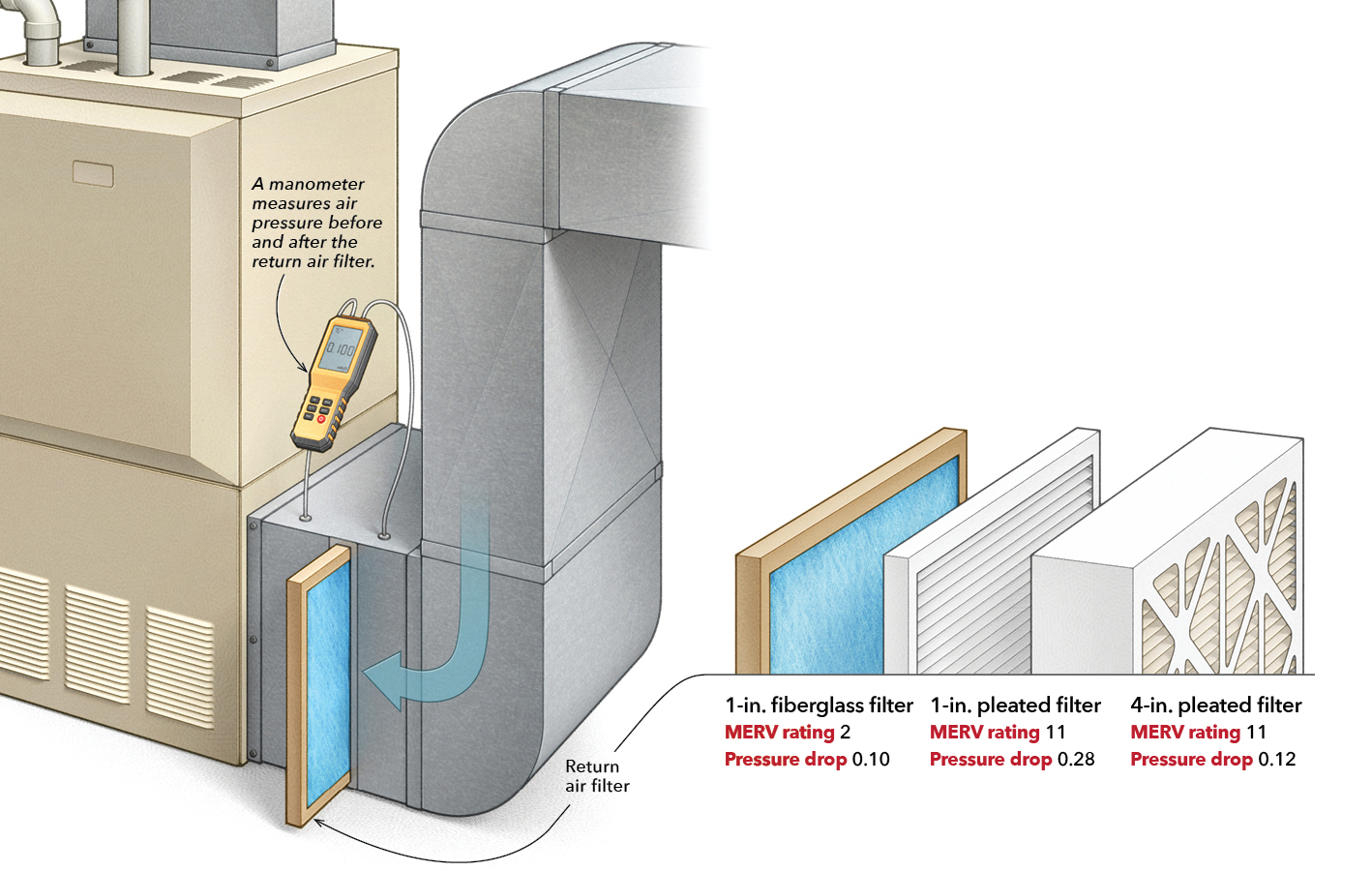
Under PressureFilters create resistance to airflow, called pressure drop. Pressure drop is measured by checking the difference in air pressure before and after the filter, and is represented in inches of water column (IWC). Maximum acceptable pressure drop ranges between 0.2 IWC and 0.25 IWC depending on the system; I like to specify filters with lower pressure drops to allow for increases as the filters fill up with particulates. When you boost a filter’s MERV rating without increasing its depth or surface area, pressure drop goes up, as it’s tougher for your HVAC system to push air through. Increasing your filter performance without affecting pressure drop may require purchasing a thicker filter with a larger filter cabinet and could even mean up-sizing ducts. |
Main Factors When Choosing Filters
A media filter consists of a mesh of fibers and a network of tiny, interconnected air spaces. The largest particles, like pet hair, are strained at the filter’s surface. Medium-size particles can fit through the spaces between the fibers, but sometimes their inertia causes them to crash into the fibers and remain lodged.
Smaller particles move more randomly, jostled by collisions with air molecules. If these movements bring the particles into contact with the filter fibers, molecular forces can cause them to stick. The slower the air moves through the filter, the more chances the collisions will end in particle capture. Electrostatic attraction can also cause positively or negatively charged particles to stick to filter media with opposite charge. Some air cleaners enhance this effect using an electric current to induce charges on particles.
Choosing the right filter involves several considerations, including the size and airflow requirements of the HVAC system and the location of the filter. I will touch on these considerations later. First, understanding filter performance requires familiarity with two parameters: MERV and pressure drop.
MERV ratings are typically shown on filters and their packaging. MERV is a 16-point scale that rates a filter’s ability to trap particles of different sizes. The higher the MERV rating, the greater the filtration efficiency—with MERV-13 to MERV-16 filters removing the highest percentage of particulate matter.
Selecting a filter based on MERV rating alone can lead to problems, however. A critical measure, pressure drop, is often overlooked by homeowners and even some contractors. Pressure drop is the resistance the filter offers to the airflow passing through it. Filters are one of the most restrictive components of a typical forced-air system, often creating more resistance than the supply and return ductwork combined. Too much resistance means poor airflow, which can show up as reduced efficiency and inadequate heating and cooling. Poor airflow also leads to other problems: cracked furnace heat exchangers, frozen air-conditioning coils, and premature fan and compressor failure.
Some manufacturers print pressure-drop data on the filter frame, while others include it in their product data sheets. For a given filter size and thickness, pressure drop tends to increase with MERV; the denser filter media, which does a better job of capturing fine particles, also offers greater resistance to airflow. It’s common to see an HVAC system that functioned well for years with low-MERV fiberglass filters. But when the homeowner, perhaps seeking to reduce pollen or dust levels, puts a MERV-11 filter in the existing 1-in. filter slot, pressure drop skyrockets, airflow decreases, and problems ensue.
So you can’t simply purchase a higher-MERV filter and call it a day. Achieving a higher MERV rating with an acceptable pressure drop usually requires thicker, pleated filters. The pleats increase the effective area of the filter media through which air flows—a 4-in.-deep pleated filter has roughly three times more internal surface area than a 1-in. pleated filter. In a retrofit, increasing filter size may require installing new filter cabinets or grilles, and may even require changes to the size of the return duct(s).
Filtering Out the OptionsThere are many types of HVAC filters, each with a different design and application, so it’s important to understand both your filtration needs and the capabilities of your system. The most widely accepted measure of filter efficiency is the MERV rating (Minimum Efficiency Reporting Value), which ranges from 1 to 16 and indicates how effectively a filter traps particles of different sizes. Filters rated MERV 1 to 4 mainly catch larger debris like pet hair and dust; those rated MERV 5 to 8 trap particles in the 3 to 10 micron range but still miss finer particles. Filters rated MERV 9 to 12 remove more than 85% of larger particles (down to 1 micron), while MERV 13 to 16 filters capture more than 90% of particles between 1 and 10 microns and more than 75% of ultrafine particles down to 0.3 microns. Below is a guide to the most common filter types, revealing the unique benefits and limitations each brings to indoor air quality and system performance.
Photos by Rodney Diaz. |


Filter Performance Can Change
Another thing to take into account is a filter’s “loading characteristics”—the way a filter’s particle-capture efficiency and pressure drop change as dust and particulates accumulate. As media filters fill, the pathways through the filter media become clogged. While this can increase a media filter’s efficiency by slowing airflow, it also increases pressure drop. Over time, this buildup can severely compromise system performance. (In contrast, electrostatic filters lose efficiency as buildup prevents the charged plates from attracting more particles.)
Changing disposable filters is critical for the performance and longevity of HVAC equipment. But how often should filters be changed? The answer depends on several factors, including the system’s airflow, the type of filter, and particulate levels in the home. The general recommendation for 1-in. filters is every 30 to 90 days during the heating and cooling seasons. Deeper pleated filters allow higher particle loading before their pressure drop becomes excessive. In many cases, they can last a year between filter changes. The longer service life of deeper filters can offset their higher per-unit cost.
Many practitioners recommend 2-in. to 6-in. MERV-13 filters for residential systems. These occupy a “sweet spot,” combining good particle-capture efficiency, acceptable pressure drop, long life, and reasonable replacement cost.
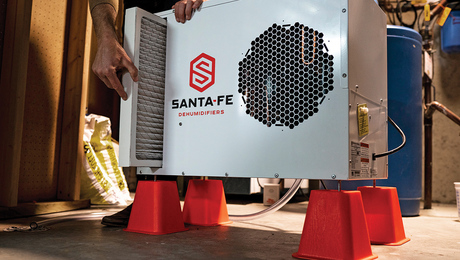
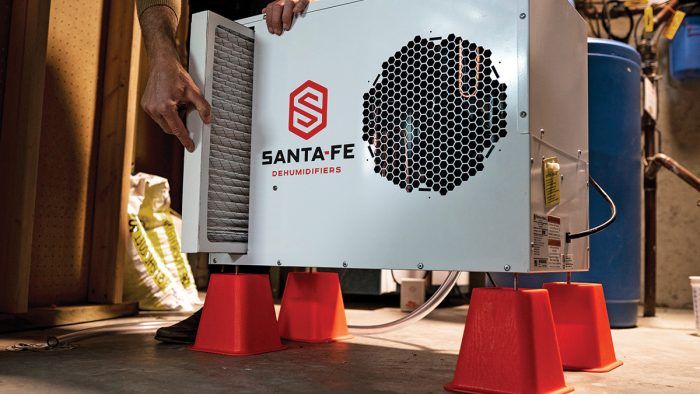
What Do You Do If You’re Ductless?For the general removal of particulates, a ducted system serving the whole house is the best bet. But what if you don’t have a ducted system? This question comes up in homes with electric or hot-water baseboard, radiators, radiant floors, and ductless heat pumps. Ductless heat pumps have integral filters, but their particulate capture is limited.  One option is a standalone air cleaner. Standalone air cleaners can provide HEPA-level filtration, capturing 99.97% of particles as small as 0.3 microns. EPA guidelines recommend a clean air delivery rate (CADR) high enough to cycle a room’s entire volume about five times per hour. Standalone air cleaners make the most sense for rooms like bedrooms, where people spend several hours each day. Like central systems, their benefits increase with run time. Using a standalone air cleaner in conjunction with a central HVAC filter can make sense for folks with severe asthma or allergies and in situations when particulate loads are excessive (for example, wildfire season in the western U.S.). Ventilating dehumidifiers are another option. A ventilating dehumidifier is a high-capacity dehumidifier with two openings for inlet air. The larger opening draws air from the house. A smaller opening, with a motorized damper, brings in a controlled amount of outdoor air through a duct. The two airstreams are mixed and passed through a media filter. From there, the air passes over a dehumidification coil and is distributed to the house. Ventilating dehumidifiers thus provide fresh air, particle removal, and moisture removal. To get this air to critical spaces like bedrooms, ventilating dehumidifiers require their own scaled-back duct system. This, plus the cost of the equipment itself, makes them a relatively expensive option. |
Filters as Part of a System
MERV, pressure drop, and loading characteristics factor into filter performance. But it’s also critical to remember that filters are part of a larger HVAC system. This brings us to three other important considerations: filter location, bypass, and run time.
Media filters are located either in wall- or ceiling-mounted filter grilles, or in the ductwork adjacent to the furnace or air handler. Filter grilles hinge open to access the filter rack. Homeowners can then change filters from the living space—an advantage if equipment is located in a hard-to-access attic or crawlspace. They also capture dust, pet hair, and other debris before it enters the return ductwork. On the downside, many filter grilles accept only 1-in.- or 2-in.-thick filters. Mounting the filter near the air handler allows the use of 4-in. to 6-in. filters, although putting the filter out of sight in a basement or mechanical room makes remembering to change it harder.
Bypass occurs when air reaches the air handler without passing through the filter. If a filter fits loosely in a filter grille, air can move around its edges; this problem can be corrected by taping the filter’s edges to the frame during each filter change. Unfiltered air can also be drawn into any leaks in the return ductwork downstream of the filter. If this ductwork passes through spaces such as unconditioned attics and crawlspaces, mold spores and insulation fibers can be distributed throughout the house. Good duct sealing isn’t just an energy measure; it’s an important form of source control.
A poorly sealed filter cabinet or an incorrectly sized, damaged, or missing filter near the air handler can also create a large bypass. And bypass increases with pressure drop; when a filter is dirty or overly restrictive, less air will pass through it, and more will move around it.
Run time—the time the HVAC system’s fan is moving air—also affects filter performance. Most air handler fans have two settings: “Auto” and “On.” The Auto setting only circulates air when the thermostat calls for heating and cooling, so filtration mainly happens during peak seasons. The On setting runs the fan continuously—usually slowing to lower speed when the thermostat is satisfied—which provides constant filtration. However, running the fan constantly has drawbacks. It can increase indoor humidity—especially in oversized systems—because moisture left on the cooling coil can evaporate back into the air. It also raises energy use. One way to balance the costs and benefits of constant air circulation is to avoid it in summer and use the On setting sparingly during other seasons.
When you understand how filters work—and how they fit into the system as a whole—you can make smarter choices that improve comfort, protect equipment, and keep your air cleaner for longer. Filtration alone won’t guarantee clean air. But if you get your filters right, you’ll give your HVAC system—and your lungs—a real advantage.
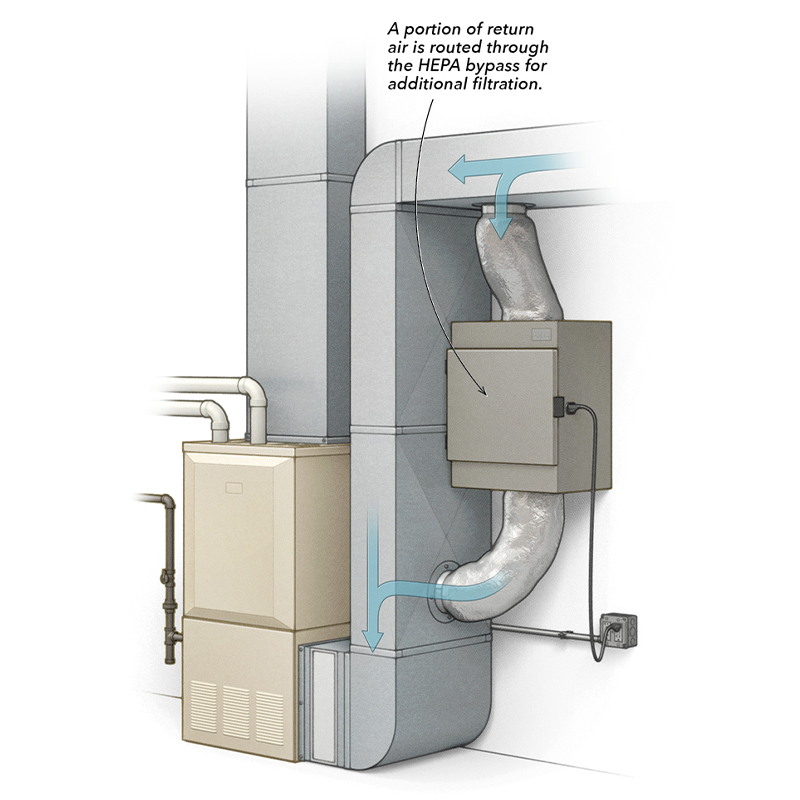
Go Further With FiltrationThere are advanced filtration options that push performance even higher. Using electrostatic forces, ultraviolet light, or extremely fine filtration media to target specific contaminants, these options can offer significant improvements in air quality; however, they also come with higher costs, installation complexity, or energy use. Each solution below takes a different approach to cleaning the air, but all are worth considering for homes with elevated concerns like allergies, odors, or biological growth.
|


— Jon Harrod; contributing editor and HVAC consultant based in Ithaca, N.Y. Photos by Brian Pontolilo.
RELATED STORIES