FHB Logo Facebook LinkedIn Email Pinterest Twitter X Instagram Tiktok YouTube Plus Icon Close Icon Navigation Search Icon Navigation Search Icon Arrow Down Icon Video Guide Icon Article Guide Icon Modal Close Icon Guide Search Icon Skip to content
Subscribe
Log In
  • How-To
  • Design
  • Tools & Materials
  • Restoration
  • Videos
  • Blogs
  • Forum
  • Magazine
  • Members
  • FHB House
  • Podcast
Log In

Fine Homebuilding Project Guides

Foundations and Masonry Work

Guide Home
  • Concrete & Masonry Basics
  • Building Foundations
  • Waterproofing Foundations
  • Retrofits and Add-ons
  • Masonry in the Landscape
  • Brick
How-To

Stone Walls That Stay Built

A master waller shares how to dry-lay stone walls that hold their ground for centuries.
By Brian Post Issue 266 - April/May 2017

Synopsis: Brian Post is a Master Craftsman–level waller, certified by the Dry Stone Walling Association of Great Britain. In this article, he explains that stone walls last longer than mortared walls, and describes how to build a dry-laid stone wall. His instructions include making sure to base the design on the site and type of stone, not worrying too much about the foundation or about fitting the face stones tightly together, forming a strong connection with hearting stones, and holding the wall together with capstone and copestones. Post describes the five essential rules of stone walling, and how they can help you build walls that will last centuries.


I began my professional training as a waller working under certified craftsmen in Great Britain, a country whose landscape is laced with stone walls that date back millennia. In New England, where I live, two-­century-old walls are common. While this may come as a surprise, that’s far longer than most mortared walls last. If you learn to properly lay dry stone, you can build walls that outlast your great-grandchildren.
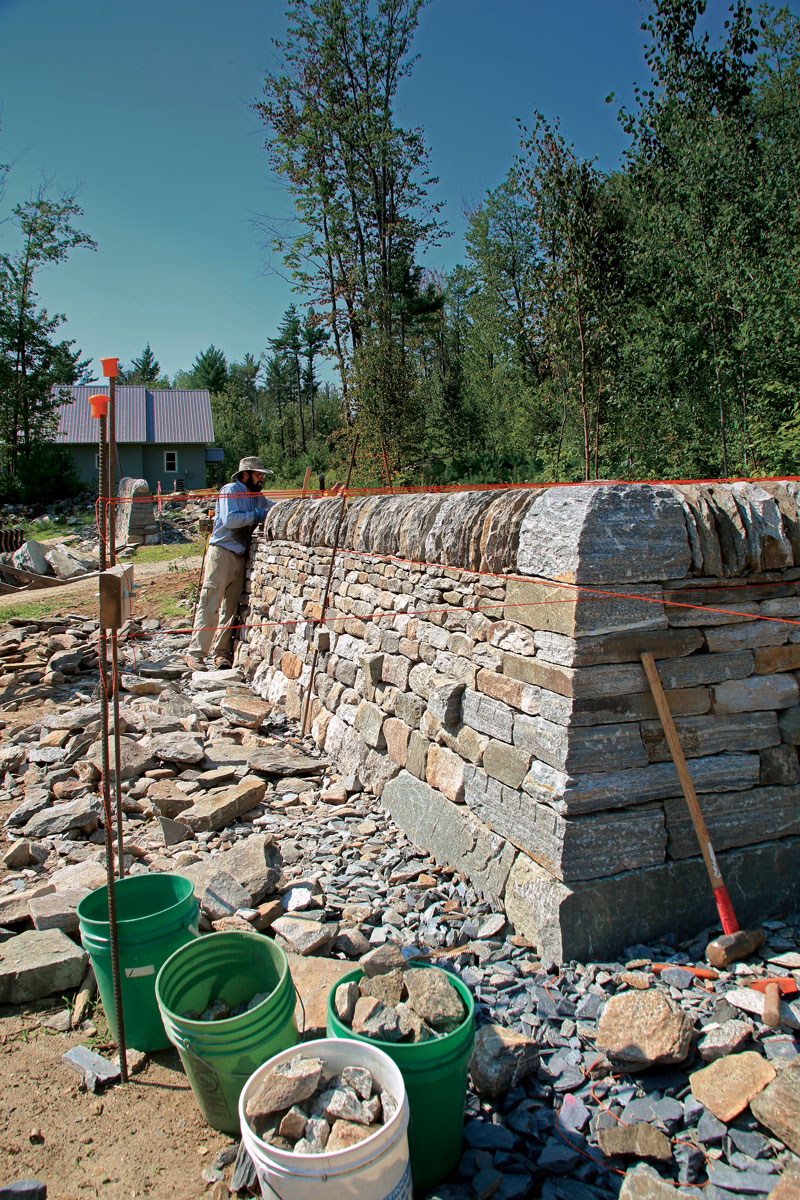
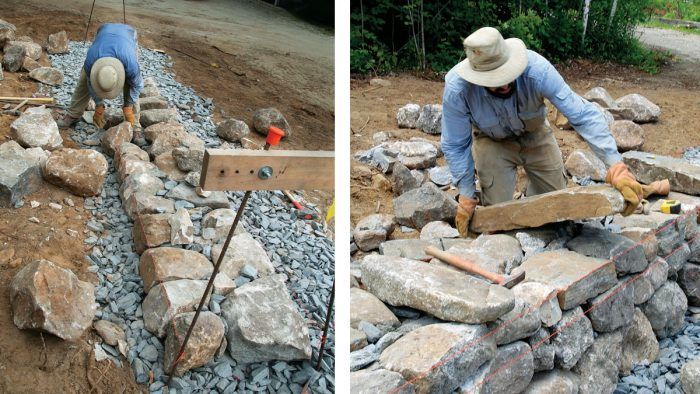
building a stone wallMortar hurts more than it helps. While it can take years of practice to efficiently build a near-perfect wall, building a good dry stone wall is quite easy. The process starts with forgetting what you think you know about the importance of mortar. One reason for their longevity is that properly laid dry stone walls flex as the ground moves, whereas a mortared wall will crack. This flexibility often allows dry stone walls to be built directly on the native soil, while mortared work requires a concrete foundation below the frost line. And while a dry stone wall allows water to pass through harmlessly, mortared walls can trap moisture that will destroy the wall when it freezes. In a dry stone wall, the aim is to use gravity to maximize friction. Friction keeps the stones from sliding apart, and their weight increases the friction. But even the best built wall can fail if it is poorly designed.

Base the design on the site and stone. When siting, think about what can damage a wall. In northern areas, set walls back from roads and driveways so that plows won’t push snow against them. Trees growing in girth can put pressure on walls, and roots can shift or lift when a tree blows in the wind, pushing a wall up from underneath. A good practice is to stay back at least 10 ft. from trees and roads. The foundation is the earth or gravel the stones rest on, and it should be dug so that it is level from side to side. If you are building on a slope with less than a 1-ft. elevation change in 20 ft., just run the wall parallel to the ground. On steeper slopes, dig the foundation in level steps like stairs. Otherwise, the stones will gradually slide downhill and cause the wall to fail.

For stability, walls should be wider at the bottom than at the top. This taper is called batter. Expressed as a ratio of run to rise, batter typically ranges from 1:6 to 1:10. A 1:6 batter means that for every 6 in. of height, the wall narrows 1 in. on each side. So, a 3-ft.-tall wall with a batter of 1:6 would be 12 in. narrower (6 in. on each side) at its top. With flatter stones, a steeper batter like 1:10 may be appropriate, while a batter of 1:6 makes a wider base that’s better for more irregular stone.

The width of a wall’s base depends on its height, the width of the top, and the batter. Walls lower than 3 ft. lack enough area for the unevenness of individual stones to blend visually into a smooth face. Narrower walls use less stone, while wider walls make it easier to use larger stone and tend to be sturdier. With these factors in mind, the top is typically 14 in. to 18 in. wide. With smaller stone or flatter stone, you can make the wall closer to 14 in. at the top. With larger or rounder stones, make the wall closer to 18 in. at the top. The size of available capstones may also influence the top’s width.

Essential rules

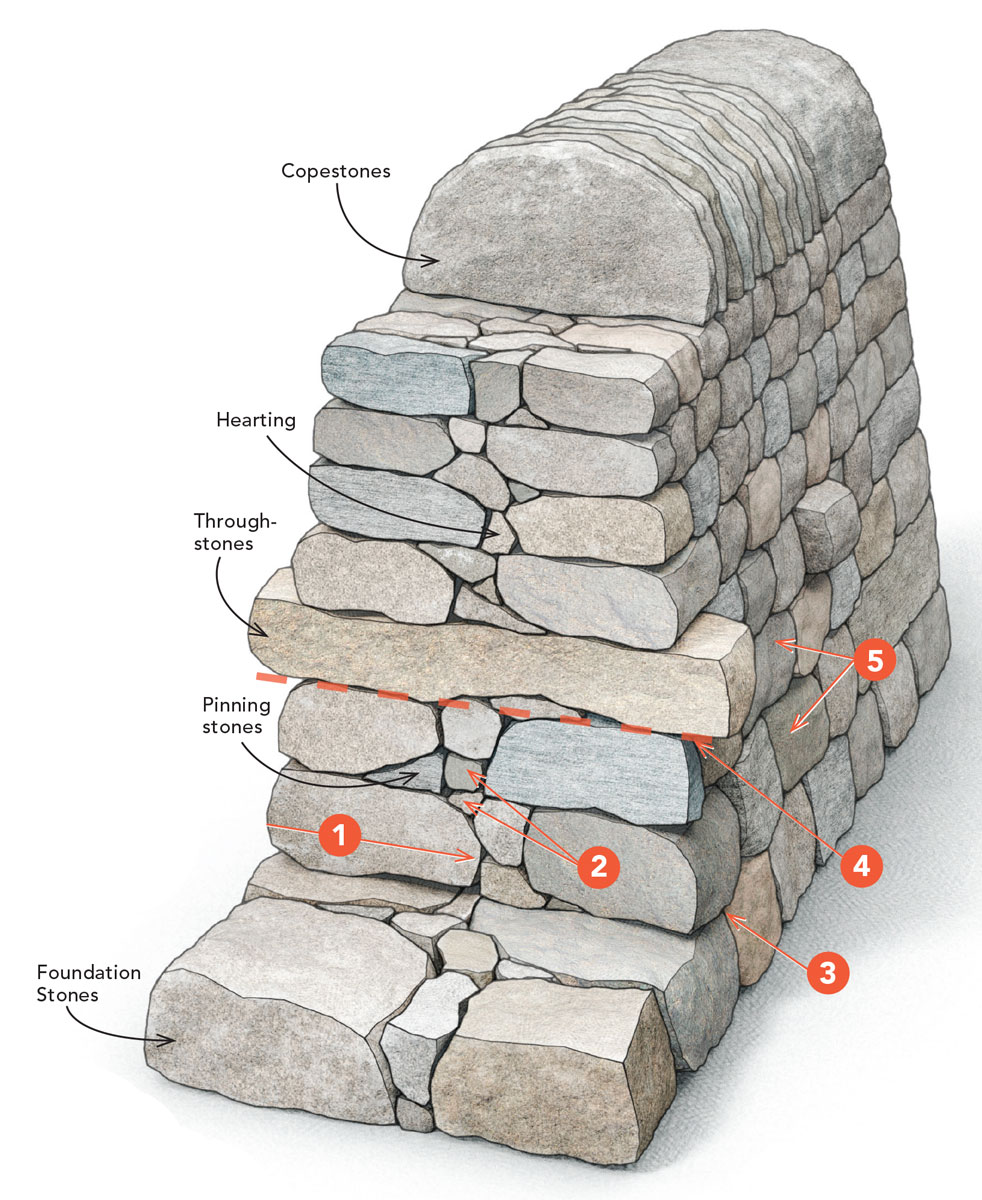
Stone Walls That Stay Built GraphicAlthough there are many more techniques that can help you build a better-looking wall or work more efficiently, those are grace notes to these five rules. Following these steps will lead to walls that last centuries.

1. Set the stones so their lengths go into the wall, not along it. Like stacked firewood, only the ends of the stones will show. Placing the stones this way maximizes the friction and puts their centers of mass closer to the wall’s core. Placing stones counter to this rule is called tracing, and is a primary reason walls fail.

2. Heart tightly. Hearting is key to a strong wall because it adds many points of contact between stones to increase friction and keep them from moving independently. Fill the voids with the biggest pieces you can. Gravel or anything you could readily shovel is too small for hearting and will act like ball bearings in the wall.

3. Cross the joints. Like brickwork, each stone should span the joint in the course below and sit firmly on the two stones on either side of that joint. Vertical joints that break this rule and run through multiple courses are called running joints.

4. Set stones level. Each stone needs to be able to support the stones above. The simplest way to achieve this is to set each stone so its top is level.

5. Build with the wall’s plane. Set stones so their faces line up on the outside face of the wall to create a smooth, even plane without hollows or overhangs, which can cause stones to tip.

Essential tools


  • Braided mason’s string
  • Batter frames, made from wood or rebar
  • Shovel
  • Tape measure
  • 2-ft. level
  • 6-ft. pry bar
  • 22-oz. brick or mason’s hammer
  • 3-lb. hammer
  • 6-lb. to 10-lb. sledgehammer

Choosing the right stone

A 4-ft.-high wall takes about 1,000 lb. of stone per linear foot, and the options vary by region. First, look for stones of a size you can move, and keep in mind that those with one longer dimension work better. Flat stone doesn’t necessarily equal good stone, and round or irregular stone doesn’t equal bad stone. Flat stone can make working with thickness variations between adjacent stones harder; plus, it’s often thin, meaning lots of courses and slower building. Rounded stone makes it easier to work with thickness variations, and each course tends to be thicker, so building goes faster. With irregular stones, build a wall whose face stones fit more loosely. With flatter stones or ones that are easy to shape, build a tighter wall.

Stone from the ground right by the wall is the traditional material to use. Old piles that were collected but never built into walls and debris from construction sites can also be good sources. For reasons of historical preservation, even with permission, harvesting stone from old walls or structures is frowned upon and may be illegal. But taking stones from walls in poor condition that aren’t visible from a road and don’t mark property boundaries is more of an ethically gray area.
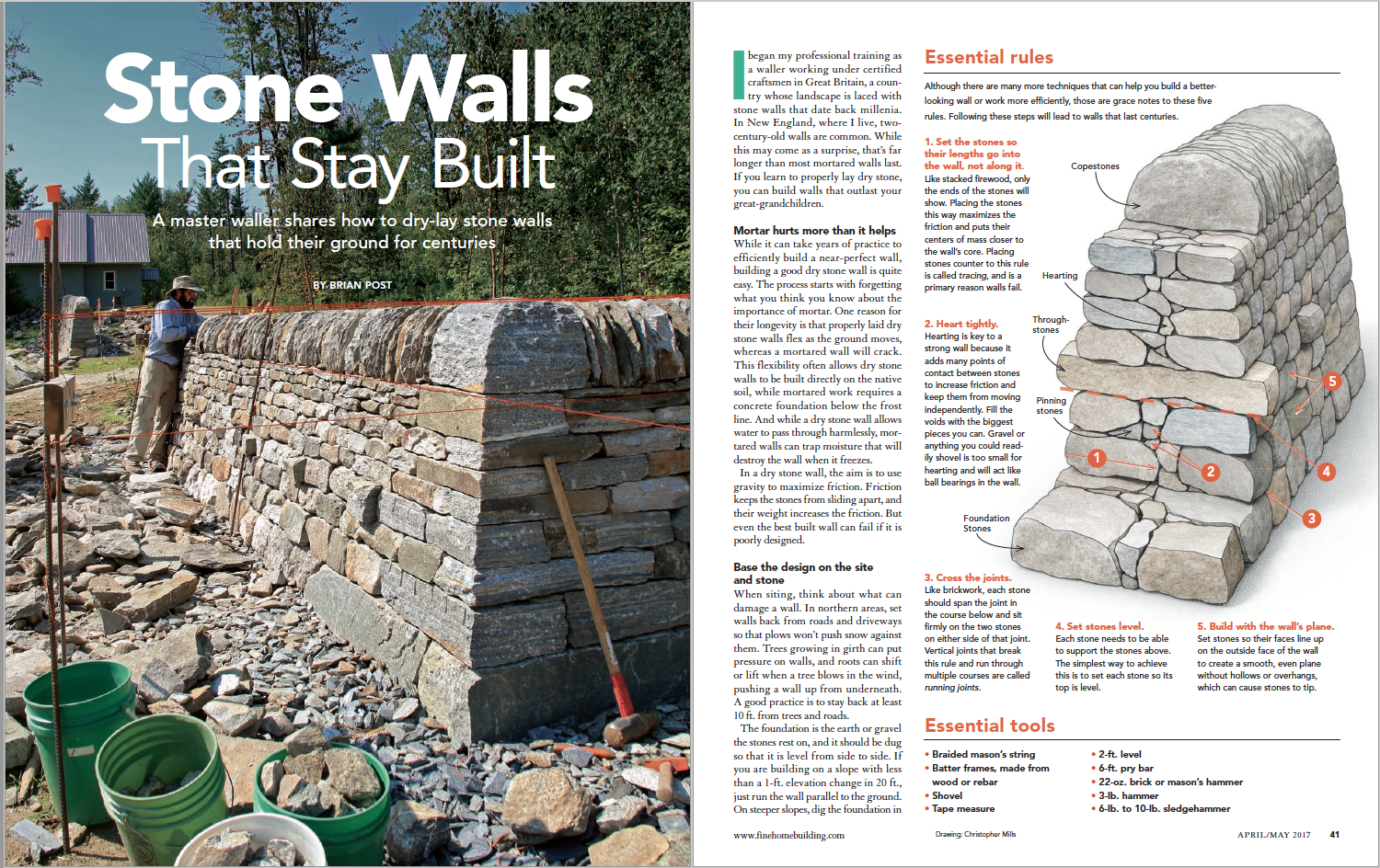
Stone Walls that Stay Built Sprd ImageLandscape architect Brian Post is a DSWA-GB certified Master Craftsman and executive director of The Stone Trust in Dummerston, Vt. Photos by Andy Engel.

For more photos, drawings, and details, click the View PDF button below:

From Fine Homebuilding #266

Sign up for eletters today and get the latest how-to from Fine Homebuilding, plus special offers.

Signing you up...

This site is protected by reCAPTCHA and the Google Privacy Policy and Terms of Service apply.
See all newsletters
See all newsletters
View PDF
Previous: Guidelines for Laying Stone Walls Next: Build a Sturdy Stone Sitting Wall

Guide

Foundations and Masonry Work

Chapter

Masonry in the Landscape

View Comments

  1. user-6901484 | Aug 23, 2017 12:35am | #1

    Great Article! Anyone have any advice on using these techniques for a retaining wall?

Log in or create an account to post a comment.

Sign up Log in

Become a member and get full access to FineHomebuilding.com

Foundations and Masonry Work

Foundations and Masonry Work

Trusted, comprehensive guidance from the pros for working with concrete and masonry

View Project Guide

View All Project Guides »

Become a member and get unlimited site access, including the Foundations and Masonry Work Project Guide.

Start Free Trial

Concrete & Masonry Basics
  • Choosing & Mixing Concrete
  • Concrete & Masonry Tools & Techniques
Building Foundations
  • Foundation Basics
  • Foundation Footings
  • Insulated Concrete Forms (ICFs)
Waterproofing Foundations
  • Waterproofing Strategies
  • Foundation Drains
Retrofits and Add-ons
Masonry in the Landscape
  • Patios, Walkways, and Driveways
  • Retaining Walls
  • Dry Stone Walls
  • Fire Pits
Brick

Fine Home Building

Newsletter Sign-up

  • Fine Homebuilding

    Home building tips, offers, and expert advice in your inbox.

  • Green Building Advisor

    Building science and energy efficiency advice, plus special offers, in your inbox.

  • Old House Journal

    Repair, renovation, and restoration tips, plus special offers, in your inbox.

Signing you up...

This site is protected by reCAPTCHA and the Google Privacy Policy and Terms of Service apply.
See all newsletters

Follow

  • Fine Homebuilding

    Dig into cutting-edge approaches and decades of proven solutions with total access to our experts and tradespeople.

    Start Free Trial Now
    • Facebook
    • Instagram
    • X
    • LinkedIn
  • GBA Prime

    Get instant access to the latest developments in green building, research, and reports from the field.

    Start Free Trial Now
    • Facebook
    • YouTube
  • Old House Journal

    Learn how to restore, repair, update, and decorate your home.

    Subscribe Now
    • Facebook
    • Instagram
    • X
  • Fine Homebuilding

    Dig into cutting-edge approaches and decades of proven solutions with total access to our experts and tradespeople.

    Start Free Trial Now
    • Facebook
    • Instagram
    • X
    • LinkedIn
  • GBA Prime

    Get instant access to the latest developments in green building, research, and reports from the field.

    Start Free Trial Now
    • Facebook
    • YouTube
  • Old House Journal

    Learn how to restore, repair, update, and decorate your home.

    Subscribe Now
    • Facebook
    • Instagram
    • X

Membership & Magazine

  • Online Archive
  • Start Free Trial
  • Magazine Subscription
  • Magazine Renewal
  • Gift a Subscription
  • Customer Support
  • Privacy Preferences
  • About
  • Contact
  • Advertise
  • Careers
  • Terms of Use
  • Site Map
  • Do not sell or share my information
  • Privacy Policy
  • Accessibility
  • California Privacy Rights

© 2025 Active Interest Media. All rights reserved.

Fine Homebuilding receives a commission for items purchased through links on this site, including Amazon Associates and other affiliate advertising programs.

X
X
This is a dialog window which overlays the main content of the page. The modal window is a 'site map' of the most critical areas of the site. Pressing the Escape (ESC) button will close the modal and bring you back to where you were on the page.

Main Menu

  • How-To
  • Design
  • Tools & Materials
  • Restoration
  • Video
  • Blogs
  • Forum
  • Project Guides
  • Reader Projects
  • Magazine
  • Members
  • FHB House

Podcasts

  • FHB Podcast
  • ProTalk

Webinars

  • Upcoming and On-Demand

Podcasts

  • FHB Podcast
  • ProTalk

Webinars

  • Upcoming and On-Demand

Popular Topics

  • Kitchens
  • Business
  • Bedrooms
  • Roofs
  • Architecture and Design
  • Green Building
  • Decks
  • Framing
  • Safety
  • Remodeling
  • Bathrooms
  • Windows
  • Tilework
  • Ceilings
  • HVAC

Magazine

  • Current Issue
  • Past Issues
  • Magazine Index
  • Subscribe
  • Online Archive
  • Author Guidelines

All Access

  • Member Home
  • Start Free Trial
  • Gift Membership

Online Learning

  • Courses
  • Project Guides
  • Reader Projects
  • Podcast

More

  • FHB Ambassadors
  • FHB House
  • Customer Support

Account

  • Log In
  • Join

Newsletter

Get home building tips, offers, and expert advice in your inbox

Signing you up...

This site is protected by reCAPTCHA and the Google Privacy Policy and Terms of Service apply.
See all newsletters
See all newsletters

Follow

  • X
  • YouTube
  • instagram
  • facebook
  • pinterest
  • Tiktok

Join All Access

Become a member and get instant access to thousands of videos, how-tos, tool reviews, and design features.

Start Your Free Trial

Subscribe

FHB Magazine

Start your subscription today and save up to 81%

Subscribe

We hope you’ve enjoyed your free articles. To keep reading, become a member today.

Get complete site access to expert advice, how-to videos, Code Check, and more, plus the print magazine.

Start your FREE trial

Already a member? Log in