FHB Logo Facebook LinkedIn Email Pinterest Twitter X Instagram Tiktok YouTube Plus Icon Close Icon Navigation Search Icon Navigation Search Icon Arrow Down Icon Video Guide Icon Article Guide Icon Modal Close Icon Guide Search Icon Skip to content
Subscribe
Log In
  • How-To
  • Design
  • Tools & Materials
  • Restoration
  • Videos
  • Blogs
  • Forum
  • Magazine
  • Members
  • FHB House
  • Podcast
Log In

Fine Homebuilding Project Guides

Framing

Guide Home
  • Introduction to Framing
  • Framing Tools, Techniques, and Materials
  • Framing Floors
  • Framing Walls
  • Framing Stairs
  • Framing Roofs
  • Efficient Framing Methods
  • Timber Framing
Tool Hound

Pneumatic Framing Nailers: Why Choose Coil over Stick?

Pro builder Justin Fink takes a look at the pros and cons of each style of nailer.
By Justin Fink

On the job site, there’s nothing you can do with a coil-style nail gun that you can’t do with a stick-style nail gun. So why would you choose one over the other? Let’s take a closer look.

Framing nailers come in two styles: coil and stick

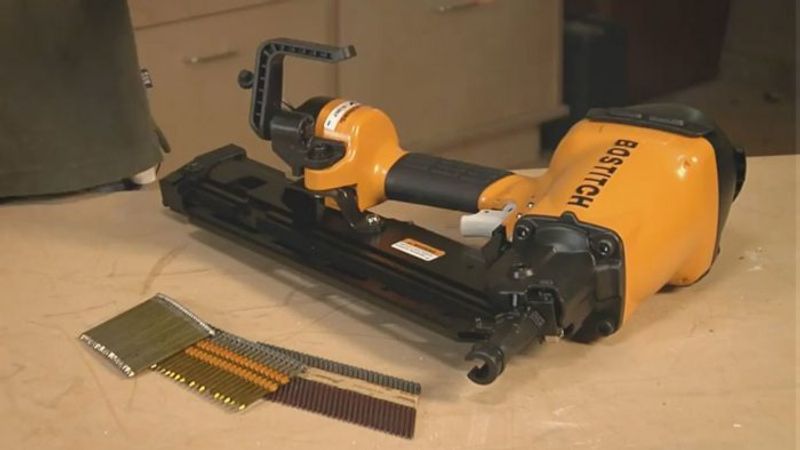
Coil nailers have an adjustable canister that accepts a coil of nails-up to 200 framing nails or 300 sheathing nails at a time–angled at 15 degrees and strung together by two thin wires welded to the shanks of the nails. These tools can fire a lot of nails between reloads. And their compact size offers some accessibility advantages. But a fully-loaded coil nailer can be heavy and unwieldy, especially for overhead work.

Coil nailers are not as popular as stick nailers, but they do have a strong foothold in the Northeast, and in a few random pockets across the country, like Louisiana, Missouri, and Texas. Despite having less market share here in the United States, this is what the rest of the world considers a framing nailer.

With stick nailers, you need to pay attention to the angle and collation style of the nails to make sure that they will fit the tool you’re using (unlike coil nailers, which all use the same style of nails). Stick nailers have a long magazine which accommodates two sticks of anywhere from 25 to 40 nails each. The nails are collated together at an angle so that the head of each nail is nested above the head of the nail in front of it. Typical stick nailers are designed to accept one of three styles of nails:

  • Plastic collated nailers fit round-head nails angled between 20 and 22 degrees
  • Wire-weld collated nailers will take will take plastic- or paper-taped nails set at 28 or 30 degrees
  • Paper collated nailers will accept sticks angled between 30 or 35 degrees, commonly just referred to as 30-degree nails

Keep in mind that regional preferences, and sometimes even building codes, will dictate which nails, and therefore which nailers, are common to your area. That’s especially important to remember if you’re purchasing your nailer over the Internet.


Sign up for eletters today and get the latest how-to from Fine Homebuilding, plus special offers.

Signing you up...

This site is protected by reCAPTCHA and the Google Privacy Policy and Terms of Service apply.
See all newsletters
See all newsletters
Previous: Hitachi’s NR83A5 Framing Nailer Next: Rebuild a Framing Nailer

Guide

Framing

Chapter

Framing Tools, Techniques, and Materials

View Comments

  1. sqjoint | Oct 31, 2012 05:42pm | #1

    Tried looking at the nailer video, but heard two voices all the time, saying the same thing, but a tremendous lag, so could understand little.

  2. sqjoint | Oct 31, 2012 05:42pm | #2

    Tried looking at the nailer video, but heard two voices all the time, saying the same thing, but a tremendous lag, so could understand little.

  3. sqjoint | Oct 31, 2012 05:42pm | #3

    Tried looking at the nailer video, but heard two voices all the time, saying the same thing, but a tremendous lag, so could understand little.

  4. sqjoint | Oct 31, 2012 05:42pm | #4

    Tried looking at the nailer video, but heard two voices all the time, saying the same thing, but a tremendous lag, so could understand little.

  5. Lawrence | Nov 02, 2012 08:03am | #5

    Colin and Justin--

    I have always used Bostich coils because they are spiral and the holding power is better when it comes to framing. The second consideration is for nailing decking and framing on cedar they tend to leave a nice clean footprint when compared with many stick nailers that may have clipped head or bits of plastic protruding.

    We often use nails for decking since nails can be set deeper for refinishing later...

    L

  6. cfristad | Oct 12, 2013 03:00pm | #6
  7. jerryjhonson | Nov 18, 2018 02:46am | #7

    That's a wonderful share. But could you specify some best products of both types? Like best stick finish nailer at this moment and best coil finish nail gun.

    Thanks.

  8. RobertPFH | Nov 04, 2021 05:19pm | #8

    Article is clear as mud.

Log in or create an account to post a comment.

Sign up Log in

Become a member and get full access to FineHomebuilding.com

Framing

Framing

Trusted, in-depth guidance from the pros for framing a durable, code-compliant house

View Project Guide

View All Project Guides »

Become a member and get unlimited site access, including the Framing Project Guide.

Start Free Trial

Introduction to Framing
  • House Framing Concepts, Tips, and More
Framing Tools, Techniques, and Materials
  • Tools
  • Techniques
  • Framing Lumber
  • Steel
Framing Floors
  • Floor Framing
  • Engineered Floors
  • Floor Sheathing
Framing Walls
  • Wall Framing Basics
  • Layout
  • Wall Assembly
  • Raising and Straightening Walls
  • Framing Rough Openings
  • Blocking
Framing Stairs
  • Stair Layout
  • Building Stairs
Framing Roofs
  • Roof-Framing Basics
  • Roof Design
  • Laying Out and Cutting Rafters
  • Framing Valleys
  • Working with Trusses
  • Dormers
  • Special Situations
Efficient Framing Methods
  • Advanced Framing
  • Double-Stud Walls
Timber Framing
  • Timber-Frame Construction
  • Timber-Frame Design

Fine Home Building

Newsletter Sign-up

  • Fine Homebuilding

    Home building tips, offers, and expert advice in your inbox.

  • Green Building Advisor

    Building science and energy efficiency advice, plus special offers, in your inbox.

  • Old House Journal

    Repair, renovation, and restoration tips, plus special offers, in your inbox.

Signing you up...

This site is protected by reCAPTCHA and the Google Privacy Policy and Terms of Service apply.
See all newsletters

Follow

  • Fine Homebuilding

    Dig into cutting-edge approaches and decades of proven solutions with total access to our experts and tradespeople.

    Start Free Trial Now
    • Facebook
    • Instagram
    • X
    • LinkedIn
  • GBA Prime

    Get instant access to the latest developments in green building, research, and reports from the field.

    Start Free Trial Now
    • Facebook
    • YouTube
  • Old House Journal

    Learn how to restore, repair, update, and decorate your home.

    Subscribe Now
    • Facebook
    • Instagram
    • X
  • Fine Homebuilding

    Dig into cutting-edge approaches and decades of proven solutions with total access to our experts and tradespeople.

    Start Free Trial Now
    • Facebook
    • Instagram
    • X
    • LinkedIn
  • GBA Prime

    Get instant access to the latest developments in green building, research, and reports from the field.

    Start Free Trial Now
    • Facebook
    • YouTube
  • Old House Journal

    Learn how to restore, repair, update, and decorate your home.

    Subscribe Now
    • Facebook
    • Instagram
    • X

Membership & Magazine

  • Online Archive
  • Start Free Trial
  • Magazine Subscription
  • Magazine Renewal
  • Gift a Subscription
  • Customer Support
  • Privacy Preferences
  • About
  • Contact
  • Advertise
  • Careers
  • Terms of Use
  • Site Map
  • Do not sell or share my information
  • Privacy Policy
  • Accessibility
  • California Privacy Rights

© 2025 Active Interest Media. All rights reserved.

Fine Homebuilding receives a commission for items purchased through links on this site, including Amazon Associates and other affiliate advertising programs.

X
X
This is a dialog window which overlays the main content of the page. The modal window is a 'site map' of the most critical areas of the site. Pressing the Escape (ESC) button will close the modal and bring you back to where you were on the page.

Main Menu

  • How-To
  • Design
  • Tools & Materials
  • Restoration
  • Video
  • Blogs
  • Forum
  • Project Guides
  • Reader Projects
  • Magazine
  • Members
  • FHB House

Podcasts

  • FHB Podcast
  • ProTalk

Webinars

  • Upcoming and On-Demand

Podcasts

  • FHB Podcast
  • ProTalk

Webinars

  • Upcoming and On-Demand

Popular Topics

  • Kitchens
  • Business
  • Bedrooms
  • Roofs
  • Architecture and Design
  • Green Building
  • Decks
  • Framing
  • Safety
  • Remodeling
  • Bathrooms
  • Windows
  • Tilework
  • Ceilings
  • HVAC

Magazine

  • Current Issue
  • Past Issues
  • Magazine Index
  • Subscribe
  • Online Archive
  • Author Guidelines

All Access

  • Member Home
  • Start Free Trial
  • Gift Membership

Online Learning

  • Courses
  • Project Guides
  • Reader Projects
  • Podcast

More

  • FHB Ambassadors
  • FHB House
  • Customer Support

Account

  • Log In
  • Join

Newsletter

Get home building tips, offers, and expert advice in your inbox

Signing you up...

This site is protected by reCAPTCHA and the Google Privacy Policy and Terms of Service apply.
See all newsletters
See all newsletters

Follow

  • X
  • YouTube
  • instagram
  • facebook
  • pinterest
  • Tiktok

Join All Access

Become a member and get instant access to thousands of videos, how-tos, tool reviews, and design features.

Start Your Free Trial

Subscribe

FHB Magazine

Start your subscription today and save up to 81%

Subscribe

We hope you’ve enjoyed your free articles. To keep reading, become a member today.

Get complete site access to expert advice, how-to videos, Code Check, and more, plus the print magazine.

Start your FREE trial

Already a member? Log in